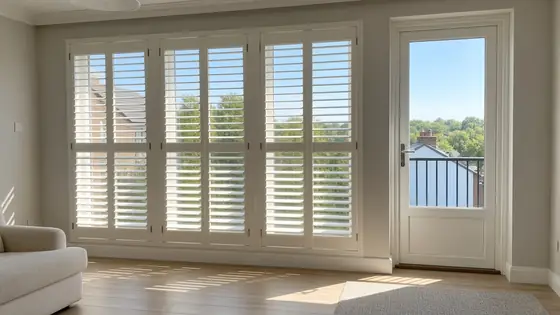
Louvres only hide you from people looking in at certain angles. Tilted with the room-side edge down, the gaps point up to the sky, which blocks someone on the pavement looking up into the window. But a neighbour in an upstairs window across the street looks down, along those gaps, and can see in. So the right setting depends on who overlooks you. Tier-on-tier panels or a split tilt rod let you angle the top and bottom louvres differently and deal with both.
The geometry, worked through
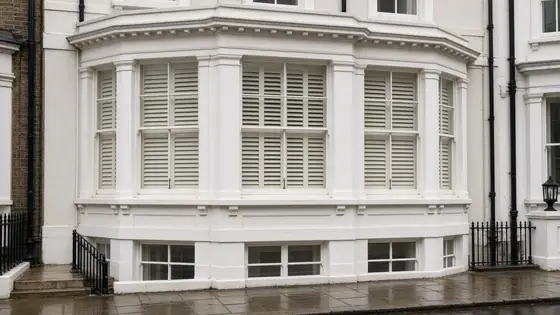
Picture a ground-floor bay on a terraced street. Someone walking past 4 m away has their eyes perhaps half a metre below the middle of your window, so they look up into it at about 7 degrees. Louvres tilted room-side down point their gaps upwards and outwards; a line of sight rising from the pavement meets the face of the louvre, not the gap.
Now take the house opposite, 12 m away, with someone at an upstairs window about 3 m higher than the middle of yours. They look down at about 14 degrees. With room-side-down louvres, the gaps run from high outside to low inside, which is the same direction as their line of sight. They see your floor and the lower half of the room. Flip the louvres room-side up and you hide from them, but now the pavement view opens up.
| Who overlooks you | Tilt | Result |
|---|---|---|
| People on the pavement | Room-side edge down | Gaps point at the sky; passers-by see louvre faces |
| Upstairs windows opposite | Room-side edge up | Gaps point at the ground; people above see louvre faces |
| Both | Split tilt: bottom room-side down, top room-side up | Each half faces the viewer it needs to block |
What each style costs on a 1.2 m window
Prices are from our plantation shutter price tables. On a three-sided bay the difference between full height and tier-on-tier is typically a few hundred pounds. A split tilt rod is the cheaper way to get most of the benefit; tier-on-tier is for people who also want to open the top panels completely for light.
| Style | Deals with | Typical fitted price |
|---|---|---|
| Café style, lower half | Pavement only | £280 to £550 |
| Full height, single tilt rod | One viewer at a time | £400 to £900 |
| Full height, split tilt rod | Both, with louvres only | Less than tier-on-tier |
| Tier-on-tier | Both, and top panels can fold fully open | £480 to £1,050 |
After dark the rules reverse
Every angle above assumes the street is brighter than your room. Once your lights are on, any gap shows the room to anyone outside, whichever way it points. Close the louvres fully in the evening. If the room is mainly used after dark, solid lower panels or a café style shutter in solid panels is the better choice. See solid panel shutters.
For ground-floor bedrooms, Approved Document O notes that lockable louvred shutters can let a window stay open securely at night, which is useful if privacy and ventilation both matter.
Bays and front rooms
A Victorian bay is the hardest case because its three faces see three directions: the side panes look along the pavement, the front pane looks across the street. It is common to set the side panels for the pavement and the front panel for the houses opposite. See plantation shutters in a bay and café style shutters.
Frequently asked questions
Which way should louvres tilt for privacy?
Room-side edge down to block people on the pavement; room-side edge up to block people in upstairs windows opposite.
Can people see through plantation shutters at night?
Yes, through any open louvre when the room is lit. Close them fully after dark.
What is a split tilt rod?
A tilt rod divided in two, so the top and bottom louvres on one panel can be set at different angles.
Are café style shutters enough for privacy?
For pavement views by day, yes. They do nothing for upstairs windows opposite or for a lit room at night.
Is tier-on-tier worth the extra over full height?
If you want to fold the top panels fully open for light while the bottom stays closed, yes. If you only need different louvre angles, a split tilt rod costs less.