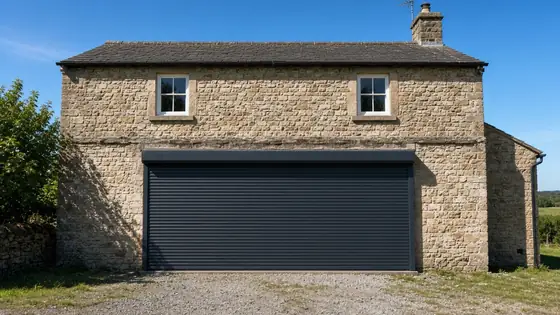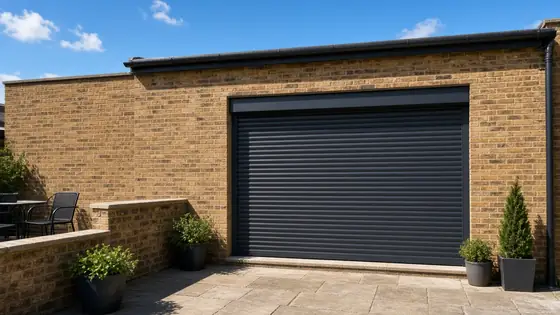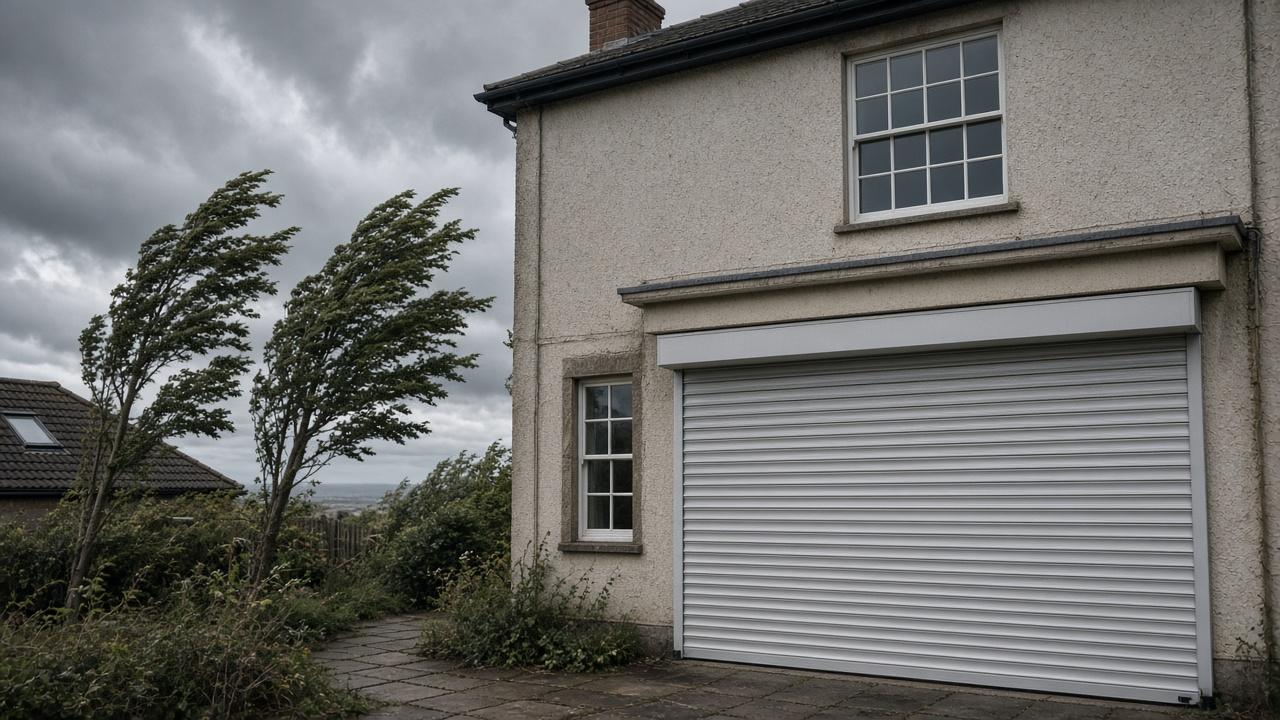
High wind turns an external roller shutter into a sail, a drum, or both. Pressure and suction on the curtain try to pull slats out of the side guides, rack the box, and fatigue the motor brake. On many UK houses the safe storm habit is to leave the shutter fully up and let the window take the weather, or to keep a purpose-rated curtain fully down and locked only when the manufacturer says that position is allowed in that wind band. A half-lowered curtain is often the worst of both worlds. Coastal fronts, tall gables and openings that funnel wind need hardware rated for the wind class and a survey that talks about exposure, not only colour charts. Shutters remain excellent for shade, privacy and overnight insulation when they are used inside their limits. Storm days are when those limits matter.
Wind load on a curtain of slats
An external roller shutter is a stack of hinged slats that forms a continuous face when closed. Wind hitting that face creates pressure. Wind tearing past the building creates suction on the lee side. Either way the curtain wants to belly, chatter in the guides, or climb out of the channels at the edges. The bottom bar and any automatic locks are there to keep the curtain seated. They are not magic against a gust the product was never classed for.
Openings on upper floors see higher wind speeds than sheltered patio doors in a courtyard. A wide bifold width is a larger sail than a narrow WC window. Corner windows and gable ends catch turbulence that a sheltered rear elevation never feels. The same shutter model can be fine on one hole and wrong on another hole of the same house.
Noise is an early warning. A drumming curtain in a gale is the slats working against the guides. Occasional flex in a named storm is one thing. Regular weekly hammering on an exposed coast is a durability problem. Ignore it and you progress to deformed slats, chewed guide liners and a motor that cuts out on obstacle detection because the curtain is no longer tracking true. To work out which part is making the noise, see roller shutter rattling in wind.
ES-SO and the solar shading world talk about external shading as a comfort and energy tool. That still depends on the mechanics. A shading product that fails in February storms will not be shading anything in July.
Open, closed, or never half way in a gale
Manufacturer instructions usually prefer one clear storm position. Many domestic manuals say raise the shutter fully when wind warnings are out, so the curtain is in the box and the window and frame take the load they were built for. Other heavy-duty or higher wind-class systems are designed to stay fully closed and locked in stated wind conditions. What almost nobody wants is a curtain stopped halfway, where the free edge can catch and the remaining span flaps.
Fully up means the box and brackets still see vibration transmitted through the wall, but the big sail is gone. Fully down means the curtain, guides and locks share the load as a tested assembly. Halfway means geometry the lab never blessed. If a remote sits at fifty percent because someone wanted dusk privacy during a named storm, finish the travel or open fully before the next gust train.
Met Office warnings and local common sense beat a phone notification from a shutter app that only knows time schedules. When a deep Atlantic low is due, override the automation. Timers that close at sunset do not read weather maps.
After the storm, run one careful cycle in daylight. Listen for new scrapes. Look for slats that sit proud of the line. A curtain that suddenly needs more force is asking for a service visit, not a higher force setting on the motor.
Boxes, guides and the wall behind them
Wind loads do not stop at the curtain. Guides transfer force into the reveals or the face of the wall. The box transfers force into brackets and substrate. Weak plugs in tired render, a box hanging off a crumbling lintel pad, or guides fixed only into thin insulation systems are failure points. Building work quality matters as much as slat thickness.
GOV.UK building regulations guidance sits in the background whenever structural openings, replacements or significant fixing patterns enter the job. A shutter survey on an exposed elevation should talk about substrate, not only motor brand. Planning Portal and local planning rules may also control how bold a box can be on a street face, which can push you toward a different box depth or a rear-elevation-first plan on sensitive houses.
Coastal air adds corrosion to the mechanical story. Salt fog attacks screws, end caps and cheap fasteners long before inland suburbs see the same wear. Specify finishes and stainless or suitable coated fixings for seafront rows. A inland-grade budget kit on a promenade house is a short story with a loud ending.
Electrical Safety First advice still applies to motorised shutters: isolation, safe cabling and competent connection. A motor fighting a wind-racked curtain will overheat and trip. That trip is protective. Raising torque limits to bully a damaged curtain through a distorted guide is how gearboxes die.
Wind classes on the datasheet, not on the brochure hero shot
External shutters are often rated against European wind resistance classes under standards such as EN 13659. The class is a tested performance for a given size and configuration, not a lifestyle adjective. A class that passes on a narrow test width may not be offered on your 4 metre bifold. Always match class to the actual opening width and the product's size chart.
Ask the supplier which class applies to your exact curtain, guides and locking option. Ask whether the rating assumes the shutter fully closed and locked. Ask what the manual says for storm warnings. If the answer is a shrug and a colour swatch, you do not yet have a specification.
Higher class usually means stiffer slats, deeper guides, stronger bottom locks, or smaller maximum widths. That can change the look of the box and the price. On an exposed west coast elevation the cheaper quiet class can be the expensive choice after the first winter.
Do not confuse burglary marketing with wind performance. Security locks help keep a closed curtain seated, which can help in wind, but a security story without a wind class on an exposed site is incomplete.
If two quotes offer different classes for the same opening, ask what changed: slat gauge, guide depth, locking, or a quieter maximum width. A cheaper quote that quietly drops a class is not a bargain on a ridge or seafront house. Put the class number on the order acknowledgment beside the opening sizes so it cannot vanish between survey and fabrication.
Survey questions for exposed elevations
Tell the surveyor which way the opening faces, how far you are from open water or open fields, and whether the house sits on a ridge or at the mouth of a street that funnels wind. Point out existing site rattles: old gates that slam, fence panels you replace often, patio furniture that migrates. Those are exposure clues.
Photo the widest openings and the highest openings. Note adjacent wings, porches and boundary walls that might accelerate wind. Ask for a written product wind class per opening, not a verbal it should be fine. Ask what storm position the manufacturer requires, and whether automation should be disabled when warnings are issued.
If the elevation is listed or in a conservation area, settle planning constraints before you fall in love with a deep storm-rated box on the street face. A rear courtyard shutter with a calmer wind story may be the first phase that actually gets consent.
For motorised systems, agree who teaches the household the storm routine. The installer who sets limits and hands over a leaflet is useful. The household that still closes halfway at dusk in a gale needs a clearer handover.
On tall glass, ask whether a single wide curtain is wise or whether split curtains with a centre mullion guide give a better wind story at the same colour. Fabricators sometimes prefer that split on exposed bifolds even when the homeowner wanted one unbroken face. Aesthetics and wind class need the same conversation, not two separate emails.
- Match wind class to each opening width, not to a generic model name
- Agree the storm position: fully up or fully down and locked
- Specify coastal fixings and finishes where salt air is real
- Override timers when named storms or local gale warnings arrive
Living with shutters when the Atlantic is busy
Most of the year, UK roller shutters do ordinary work: night privacy, summer shade, a warmer pane on cold evenings. High wind days are the exception routine. Put it on the family calendar the same way you check the greenhouse clips. Raise or lock as instructed, then leave the product alone until the gusts drop.
If you holiday-let a coastal cottage, print the storm instruction beside the remote. Guests will follow a clear card. They will not read a PDF in a drawer while the bifold drumms.
Service intervals on exposed houses should be tighter. Guides need clean liners. Locks need to meet the sill. A small bend fixed early is a cheap visit. A curtain torn from a guide in the night is a fabricator job and a wet room.
Used inside their wind class, with a sane storm habit, external shutters earn their keep on British elevations that see weather. Used as unrated sails on a cliff-top glass wall, they become maintenance. Choose the first path on purpose at survey, not after the Met Office names the storm.
Frequently asked questions
Should I close shutters before a storm?
Follow the manufacturer for your wind class. Many domestic systems prefer fully raised in high wind. Some rated systems may stay fully down and locked. Avoid leaving them half way.
Why does my shutter bang only on one elevation?
That opening likely sees stronger pressure or suction. Width, height and funnelling from nearby walls all change the load. The quiet side of the house is not the design guide for the noisy side.
Does a higher motor force setting fix wind noise?
No. Noise is a load and fit problem. Raising force can damage a curtain that is already flexing in the guides.
Are coastal houses harder for shutters?
Usually yes. Higher exposure and salt corrosion both matter. Ask for suitable classes, fixings and finishes, and expect more frequent checks.
Will planning stop a storm-rated box on the front?
It can on protected or sensitive street faces. Check Planning Portal guidance and your council early, and consider calmer rear openings first if consent is tight.