Yes, an arched window can take plantation shutters, but the arch itself is usually a separate shaped panel that stays fixed or hinges for cleaning, while the rectangle below opens as normal. A shallow arch can instead be built into the tops of opening panels. Either way the shape is surveyed or templated, because UK suppliers that sell shutters online do not take shaped windows through their online measuring forms. An external roller shutter cannot follow a curve: its box and side guides cover a rectangle, so it either fits below the spring point of the arch or not at all.
Key points
- There are two layouts. Shuttercraft describes splitting the window into a rectangle of standard shutters with a separate shaped arch panel above it, or building half of the arch into each of two opening panels.
- A separate arch panel is often fixed or only hinged for cleaning. Hunter Douglas says the arched shutter can stay fixed in place while the panels below open, and Shuttercraft says the upper shutter usually becomes decorative only.
- Louvres in the arch can fan out like a sunburst or run horizontally to match the panels below. Both are offered by Hunter Douglas and Shuttercraft, and ShuttersUp says the louvres in the arch can still be adjustable.
- Shaped windows are a survey job. The Shutter Shop says shaped windows cannot be ordered through its online DIY service, and Shuttercraft says an arch will not fit unless it is precisely measured.
- Material choice narrows for shapes. S:CRAFT rates one of its ranges suitable for all special shapes, another for limited special shapes and a third not suitable for special shapes at all.
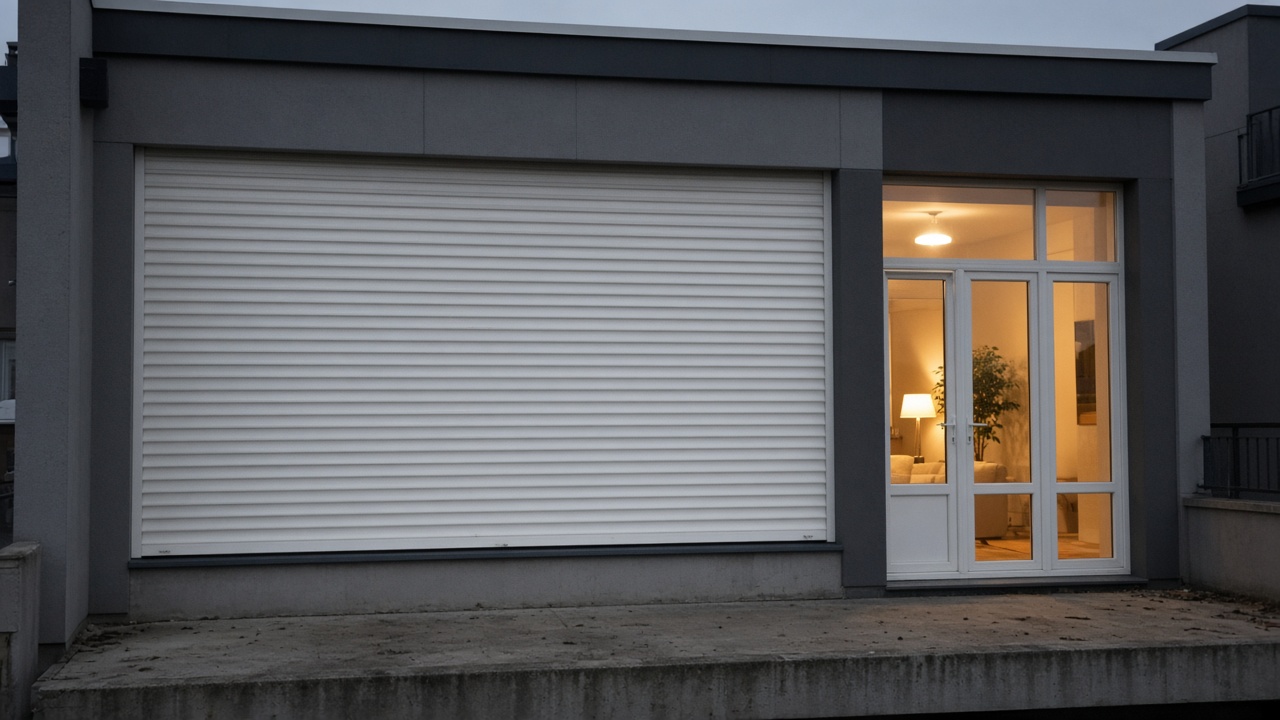
- External roller shutters hang straight from a barrel above the opening between two vertical guides, so on an arched window they can only cover the rectangle below the curve.
Which arch shapes can open and which stay fixed
Arched windows come in more shapes than people expect. Hunter Douglas lists traditional, elongated, quarter round, half moon, half circle, eyebrow and Gothic arches, and ShuttersUp's list of special shapes includes half round, double half round, eyebrow, quarter round, elongated and a sunburst above a rectangle. What decides whether the arch part can open is how much of the window it takes up and whether it can be split into panels that swing clear of each other.
Fixed does not have to mean the louvres are fixed. ShuttersUp says the arch section can be joined to the main shutter or kept separate, and that a separate arch can still be opened, closed and adjusted on its own, so you can tilt the top louvres for light without touching the panels below. Whether every louvre in a curved panel can be linked to one tilt mechanism depends on the maker, so ask which louvres in your arch will move and which will be set at a fixed angle.
The table below sets out the usual answer for each shape, based on the layouts UK shutter companies publish. It is a starting point for the survey, not a promise: the maker and the depth of your reveal decide the final design.
| Arch shape | Can the arch part open? | Usual solution | Notes |
|---|---|---|---|
| Full or half round arch over a rectangle (a perfect arch, height half the width) | Sometimes. The arch panel is often fixed or hinged for cleaning only | Rectangular opening panels below, a separate shaped arch panel above with a sunburst or horizontal louvres | Shuttercraft says the arch panel is usually hinged at the bottom for window access and usually decorative only |
| Segmental or eyebrow arch (shallower than a half circle) | Often, because the curve is shallow enough to build into the panel tops | Two or more opening panels with shaped top rails, or a fixed eyebrow panel above a rectangle | Blinds.com notes an eyebrow is shorter than a perfect arch and, where it has straight legs, needs four measurements: width, height and both leg heights |
| Gothic or pointed arch | The lower section can. The pointed head is usually a fixed panel or two fixed halves | Opening panels to the spring point, shaped fixed panel above | Named as an arch type by Hunter Douglas. Shuttercraft fits church and triangular arches by the same split method |
| Quarter round (a right angle with the curve opposite) | Rarely. Usually a single fixed panel | One shaped panel, often next to a rectangular window | Blinds.com says a quarter arch may need mounting on both sides, so it needs a solid mounting surface on the bottom and the side |
| Sunburst over a rectangular window (separate fanlight) | The sunburst normally does not; the window below does | Separate frame or shared frame with a fixed sunburst panel on top | ShuttersUp lists a sunburst above as a standard special shape; Hunter Douglas describes louvres that follow the curve for a sunburst effect |
| Full circle (porthole) | Not usually stated by makers | One round shaped panel | Just Shutters and Shuttercraft both make round window shutters but do not publish whether they open |
Why an arch needs a template or a survey
A rectangle is measured with three widths and three heights. An arch is not that simple, because very few arches in UK houses are true geometric curves. Shuttercraft says arched shutters are a much more complicated process than rectangular ones, with several angles to consider, and that the arches it has measured in period properties are sometimes imperfect. Its conclusion is blunt: the arch will not fit unless precisely measured.
Blinds.com, a US retailer, sets the rule out plainly in its arch measuring guide: an arch is only a perfect arch if its height is exactly half its width, and when it is not, you may need to supply a paper template of the window. A template is a full size sheet of paper or card traced to the curve inside the reveal, so the workshop can cut the frame to the real shape rather than to a drawing. Ask your supplier how they want it marked and sent before you make one.
UK suppliers handle this by sending someone. The Shutter Shop's DIY measuring guide says bay windows, tracking systems and shaped windows are not available to order online, and asks customers with one to get in touch, offering a video survey. ShuttersUp says your own measurements are only for a quote and that a surveyor takes the manufacturing measurements before anything is made. S:CRAFT advises against measuring arched windows yourself, because a couple of millimetres out can affect the fit. Our guide to measuring for plantation shutters covers the rectangular part, and what a shutter survey should measure lists what the surveyor should record.
- Measure in millimetres, as ShuttersUp recommends, and note the width at the spring point, where the straight sides stop and the curve starts.
- Measure the height of each straight side to the spring point separately. Blinds.com says both legs of an eyebrow should be measured, since they may differ.
- Measure the diagonals of the rectangular part. ShuttersUp says a difference means the window is out of square, which affects the choice of frame.
- Check the depth of the reveal all round the curve. ShuttersUp notes there must be enough depth for the frame and for the louvres to open.
Design choices: separate arch or shaped tier, sunburst or horizontal
The first choice is whether the arch is a panel of its own. Shuttercraft calls the two options isolating the arch and including the arch. Isolating it puts a frame across the window at the spring point, standard shutters below and a shaped shutter above. Including it surrounds the whole window with one frame and gives each of two panels half of the arch, which Shuttercraft says lets in the maximum amount of light when they are opened. The first is simpler and suits tall half round heads. The second suits shallow arches where a separate panel would be a thin sliver.
The second choice is the louvre direction in the arch. Hunter Douglas offers louvres that follow the shape of the window for a sunburst effect, or louvres that run horizontally to match the other shutters in the room, and Shuttercraft offers both on its arched range. A sunburst reads as part of the window. Horizontal louvres read as part of the shutter below and line up with it when the lower panels are closed.
The third choice is where the dividing posts go. If the rectangular part needs T-posts because it is too wide for two panels, ask the designer to line them up with the centre of the arch or with the divisions in a sunburst, so the vertical lines carry through. A post that lands off centre under a symmetrical arch is the detail people notice once the shutters are in. ShuttersUp also lets customers choose the tilt rod position and louvre size, which matters more on a shaped panel where a visible rod crosses the curve.
If the window is in a bay, the arch adds to the angles the surveyor already has to deal with; our guide to plantation shutters in a bay covers those. For a quick view of which shutter type suits the rest of the room, try the shutter finder.
Frame, material and mounting limits
Not every range can be made in a curve. S:CRAFT's arched shutter page rates its Fiji range suitable for all special shapes and solid panels, its Java range for limited special shapes, and its Antigua range not suitable for large installations or special shapes. So the material you like in a showroom may not be offered for the arch, and you may need the same finish in a different range to keep the window consistent. Our guide to wood versus waterproof shutters explains the trade offs between materials.
Weight matters on a tall arch. Shuttercraft's arched window FAQ says interior shutters are heavier than most window coverings and that some windows may not support them, which is why the frame is fixed to the reveal or the wall around it, not to the window. A quarter round or an arch over a deep reveal also needs somewhere solid to fix at the bottom and side; Blinds.com makes the same point about quarter arches.
Finally, check what the shutter has to clear. The Shutter Shop's guide warns about big handles, alarm sensors and inward opening windows, and says the backs of the louvres must be free of obstructions. On an arched casement with a handle near the spring point, that can decide where the frame divides.
Why an external roller shutter cannot follow an arch
An external roller shutter is a straight curtain of slats. Designing Buildings describes the slats coiling round a barrel housed above the window opening and moving vertically within guide rails, and says the rails must be plumb and parallel. AvosDim's UK measuring guide for domestic roller shutters has the guides supporting the roller box on top and asks for three sets of measurements of the structural opening, using the smallest. None of the maker and supplier guides we read offer a curved box or a curved curtain.
Put together, that means a roller shutter covers a rectangle: a straight box across the top, two straight guides down the sides. On an arched window there are only two options. Either the box sits at the spring point and the shutter covers the rectangular part, leaving the arch as bare glass above it, or the box goes on the wall above the whole arch and the shutter covers the window as a plain rectangle, hiding the arch completely when down. Many owners find the first looks unfinished and the second defeats the point of the arch, which is why the usual answer for an arched window is an internal shaped shutter, or no shutter at all.
If security or summer heat is the reason you wanted a roller shutter, read our guide to external roller shutters in the UK for the rectangular windows in the house, and accept that an arched feature window may be the one opening left with internal shutters only.
Cost: expect shape to be priced in
We do not publish a price for arched shutters, because we have not found enough independent published figures to give a fair range. What sellers do say is that shape is a cost factor. Shuttercraft lists special shape among the things that set the price, Plumbs says pricing depends on the size and complexity of the window, and Homebuilding and Renovating describes custom shutters for bay, arched or unusually shaped windows as among the trickiest and most expensive to fit. Ask for the arch to be priced as its own line on the quote. For general figures see our plantation shutter cost guide.
Frequently asked questions
Can you put plantation shutters on an arched window?
Yes. The usual design is standard opening panels on the rectangular part with a separate shaped panel in the arch, or two opening panels that each include half of the arch. Shuttercraft, ShuttersUp and Hunter Douglas all describe these layouts.
Do arched shutters open?
The lower panels open as normal. A separate arch panel is often fixed, or hinged only for cleaning; Hunter Douglas says the arch can stay fixed while the panels below open, and Shuttercraft says it is usually hinged at the bottom for window access. Where the arch is built into the panels, it opens with them.
Do the louvres in the arch move?
They can. ShuttersUp says the top arch can still have adjustable louvres and a separate arch can be adjusted on its own. Ask the maker which louvres in your shape link to the tilt mechanism and which are set at a fixed angle.
Can I measure an arched window myself?
You can take rough measurements for a quote, but the manufacturing measurements are normally taken by a surveyor. The Shutter Shop does not take shaped windows through its online DIY service, and S:CRAFT warns that a couple of millimetres out can affect the fit. Non perfect arches may need a paper template.
Can a roller shutter go on an arched window?
Only on the rectangle below the curve, or as a plain rectangle over the whole window. A roller shutter hangs from a straight barrel between two vertical guides, so it cannot follow the arch.
Are shutters for arched windows more expensive?
Sellers say shape and complexity affect the price, and Homebuilding and Renovating calls shutters for arched windows among the most expensive to fit. Ask for the arch to be priced as a separate line so you can compare quotes.
Sources and further reading
- Shuttercraft: arched shutters (isolating or including the arch, arch panel usually hinged at the bottom and decorative, precise measuring needed)
- Shuttercraft: choosing shutters for arch windows (two layouts, arch panel hinged at the bottom, louvre control on arches)
- Shuttercraft: arched window shutters (sunburst arch or horizontal louvres, weight of interior shutters)
- Shuttercraft: are wooden shutters a good investment (special shape listed as a cost factor)
- Hunter Douglas: arched window treatments (arch styles, fixed arch with opening panels below, sunburst or horizontal louvres)
- ShuttersUp: bespoke shaped shutters for arched windows (adjustable louvres in the arch, joined or separate arch)
- ShuttersUp: special shape shutters (named shapes including eyebrow, quarter round and sunburst above)
- ShuttersUp: how to measure for shutters (millimetres, surveyor measures for manufacture, out of square windows, recess depth)
- ShuttersUp: arched window plantation shutters (tilt rod placement and louvre size)
- The Shutter Shop: DIY measuring guide (shaped windows not available to order online, obstructions behind louvres)
- S:CRAFT: arched shutters (which ranges suit special shapes)
- S:CRAFT: how to effectively cover arched windows (professional measuring, a couple of millimetres affects fit)
- Just Shutters: special shapes (arches, triangles and portholes)
- Shuttercraft: round window shutters
- Blinds.com: how to measure for arches (perfect arch definition, paper template, eyebrow and quarter arch measurements)
- Plumbs: shaped shutters (price depends on size and complexity)
- Homebuilding and Renovating: cost of window shutters (custom shutters for arched windows among the most expensive to fit)
- Designing Buildings: window roller shutters (barrel above the opening, slats move vertically in guide rails)
- Designing Buildings: step by step guide to roller shutter installation (guide rails plumb and parallel)
- AvosDim: measuring for a made to measure domestic roller shutter (box on top of guides, three sets of measurements of the structural opening)