 Local Shutter Installers
Quotes · Long note
What a shutter survey should measure
Updated
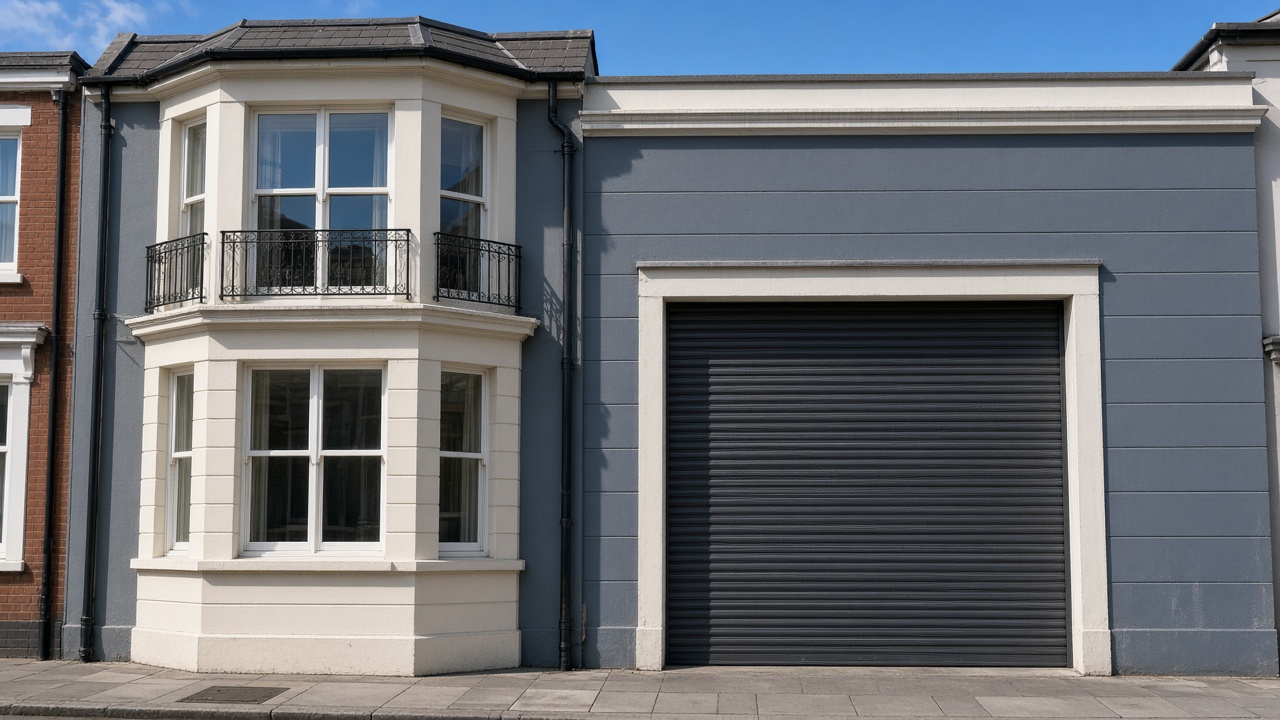
A shutter survey measures the opening, the wall, the sky and the rules on that elevation. It does not start with a colour chart. If nobody has put a tape on the reveal, you do not have a price, you have a guess.
The opening, in millimetres
Width at the top, middle and bottom. Height on both sides. How far the reveal is out of square. Roller shutters bind when a single factory width meets a wandering brick reveal. The fitter should write the manufacturing size and the deductions, not only the 'about a metre and a half' from the homeowner.
Handles, tracks, trickle vents, alarm contacts and the place a bottom bar can actually land. A sloping sill or a bifold track that leaves a gap under the bar will spoil the security story and the draught story together.
The wall the guides have to trust
Brick, block, timber frame, render on insulation, or a uPVC frame that is mostly air chambers. The fixing changes. A guide screwed into a weak sash can pull the window apart over a summer of motor cycles. If the frame is the wrong substrate, the guide goes on the wall, or the job waits.
Headroom for the cassette, including horns, downlights and gutters. The box size comes from the curtain height and the slat, not from the gap you wish you had. Note damp, failed lintels and crumbling mortar. A shutter is not the repair for a cracked brick arch.
Sky, wind and the street
If the drive is solar, stand where the panel will sit. Trees, soffits and north aspects are the conversation. If the elevation is a wind tunnel or a coast, the wind class is the conversation. If the street is a conservation area or the building is listed or a flat, the permission is the conversation. A survey that only discusses slat colours has skipped the reasons jobs are cancelled.
Photographs are for the file, not for the measure. They help a second person in the office see the eaves. They do not replace the laser.
The brief, in one sentence
Heat on the bifold, blackout in the nursery, delay on the rear door, or a shop that must still look open at noon. Those sentences specify different products. A surveyor who does not ask will sell the shutter they came out in the van to sell.
Ask what is excluded: scaffold, making good, electrics, planning drawings, the lantern, the side light. Exclusions are acceptable when they are written. They are how two quotes a thousand pounds apart can both be 'for the shutter'.
Paper you should leave with
A written list of the sizes, the product names, the colour reference, the motor model, and a statement of who manufactures and who warrants labour. A date for manufacture only after any consent you still need. A note on how the door opens if the motor fails.
If the visit was free because it was a sales call, that is fine, provided the measure still happened. A price from a web form without a visit is a budget. Do not send it to a factory.
Red flags
A single price for 'the house' with no openings listed. A promise that planning is never required. A solar kit offered for a panel that will sit in a porch. A security claim with no profile and no standard. A fitting date this week for a made-to-measure wide door.
None of these require expertise to spot. They require reading the paper slowly, which is the homeowner's half of the survey.
Two measures, then a size
Widths at three heights and heights at both jambs catch a reveal that wanders. Brick openings do wander. The manufacturing size is a deduction from the tightest dimension, with clearance for the guides, not the average of a hopeful tape. If two firms disagree by more than a few millimetres, do not split the difference. Watch a third measure or ask one of them to mark the laser points while you look.
Square is a separate question from size. A parallelogram opening makes a rectangular curtain look drunk. Packing, a different guide, or a decision not to proceed are all better than a factory width that binds on one side.
The services in the way
Alarm contacts, outside lights, trickle vents, cat flaps and the odd soil pipe boxed into a soffit all steal space. A shutter quote that has not looked up will discover the downlight on fitting day. Moving a light is a small extra when it is written down and a grievance when it is not.
Electrics for a wired motor need a route that is not a fresh stab through the cavity. If the drive is solar, the survey still marks the panel's sky. Both sentences belong in the notes even if you think you have already chosen.
The brief written back to you
Before you accept a price, the fitter should be able to repeat your brief in one line: heat on the doors, dark in the front bedroom, delay on the rear, or a shop that must look open at noon. If their line is 'supply and fit shutters' you have not been heard, and the product that arrives may be the one on the van.
Ask what they would refuse. A useful surveyor has a no ready for a listed front, a hopeless solar position, or a rotten frame. A surveyor who only has yeses is a salesperson with a tape measure.
If the brief is one sentence
Write the brief for What a shutter survey should measure before the brand. In this stand-in, the house is in Bristol. Solar retrofits on rear bifolds, and a harder no on street-facing Georgian windows. If the sentence is heat, a solid curtain or a screen are both still in play. If the sentence is a harder door at night, a screen is the wrong tool. If the sentence is a bay on a polite street, an external roller may be the wrong tool entirely.
Hills, stacked terraces and conservation streets in Clifton sit next to ordinary family houses in the south of the city. That is the setting, not a promise that every street in Bristol can take a box. What a shutter survey should measure still has to survive the particular elevation, the particular reveal and the particular freeholder if there is one.
The example, kept small on purpose
One opening: 1.5 by 2.35 metres, drive taken as a solar motor, illustration £2,658. What a shutter survey should measure is not that price. A wide bifold, a scaffold or a planning drawing moves it. A second window on the same day usually costs less than a second visit.
The worked opening for What a shutter survey should measure is 1.5 m wide by 2.35 m high, 3.53 square metres of glass. This figure puts 545 watts per square metre on the pane and uses a g-value of 0.76, about 1462 watts into the room if the curtain is up. An opaque external shutter, taken as stopping 90 percent of that gain while it is fully down, leaves about 146 watts and keeps about 1316 watts out. That is a noon figure for comparison. An internal blind does not get the same reduction. For What a shutter survey should measure, use the noon figure to compare two openings on the same house, then let a measured survey replace the figure.
Hold the winter figure beside it rather than in a separate sales conversation. Winter figure for What a shutter survey should measure: glass at 2.6 W/m2K, 3.53 square metres, a 12 degree inside-outside gap and eight night hours. The bare pane is about 0.88 kWh a night on that crude sum. A closed shutter cutting about 30 percent of the flow leaves 0.62 kWh and saves about 0.26 kWh a night, only while it is down. Open it when you want winter sun.
Handover, or the product will not be used
Run the curtain twice while someone stands in the room and listens for a bang. Set the dusk close. Point at the solar panel, if there is one, and say what must not be painted. For What a shutter survey should measure, write the motor brand and the curtain maker on the same page. One of those names will be the wrong one to phone in year six if you only kept the other.
Steep streets and limited van parking should be priced before the deposit. Access is part of the price. So is a no. Stop What a shutter survey should measure if the solar panel would sit in a soffit with no sky, and the quote has no wired alternative. A photograph is not a manufacturing size.
What to do with this note
What a shutter survey should measure is a long note because the decision is a pile of smaller ones: which pane, which side of the glass, which box the wall can carry, whether anyone may refuse the look, and whether you will actually lower the curtain. The 1.5 by 2.35 metre example, the solar motor, and the £2,658 illustration are there so those decisions have numbers attached. They are not an order form.
Take the openings that hurt into a survey. Leave the ones that do not. Ask the fitter to repeat the brief in a sentence you recognise. If they cannot, you are being sold a range rather than a remedy. Compare the next quote against the slat, the drive and the exclusions, not against a single bold total.
Keep the summer close and the dusk close as separate habits. What a shutter survey should measure fails if the hardware is perfect and the curtain stays in the box. It also fails if you fit it on a front the council will make you remove. The successful version is smaller than a whole-house fantasy and more specific than an advert for German streets.
Questions worth asking the fitter
Can the fitter measure from photos?
Photos can rule a job out. They cannot size a curtain. Pay for a visit before manufacture.
How long should a survey take?
Long enough to measure each opening twice and to look at the head, the sill and the sky. A five-minute hallway conversation is not a survey.
What if two surveys disagree on width?
Do not average them and hope. A third measure, or a fitter who will show you the laser on the reveal, is cheaper than a curtain that does not fit.