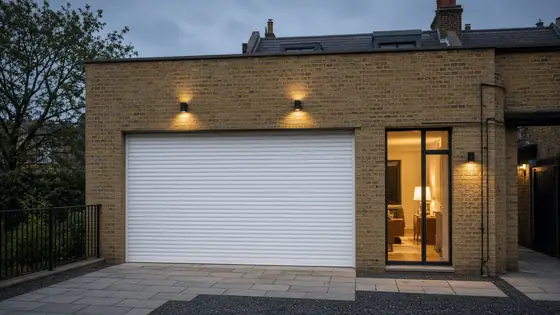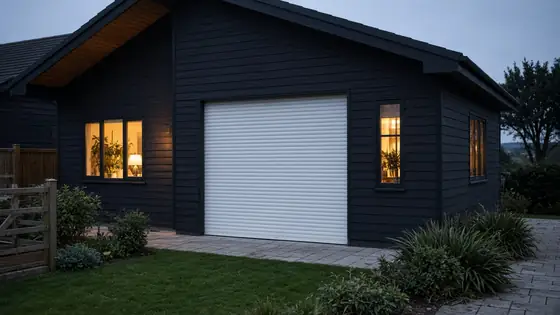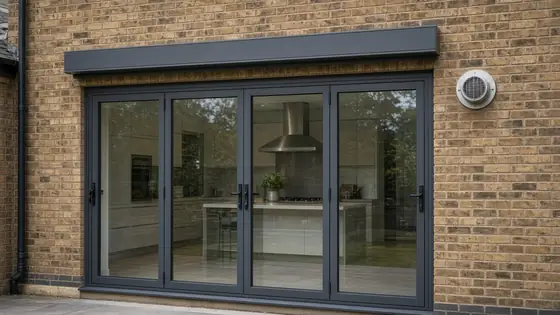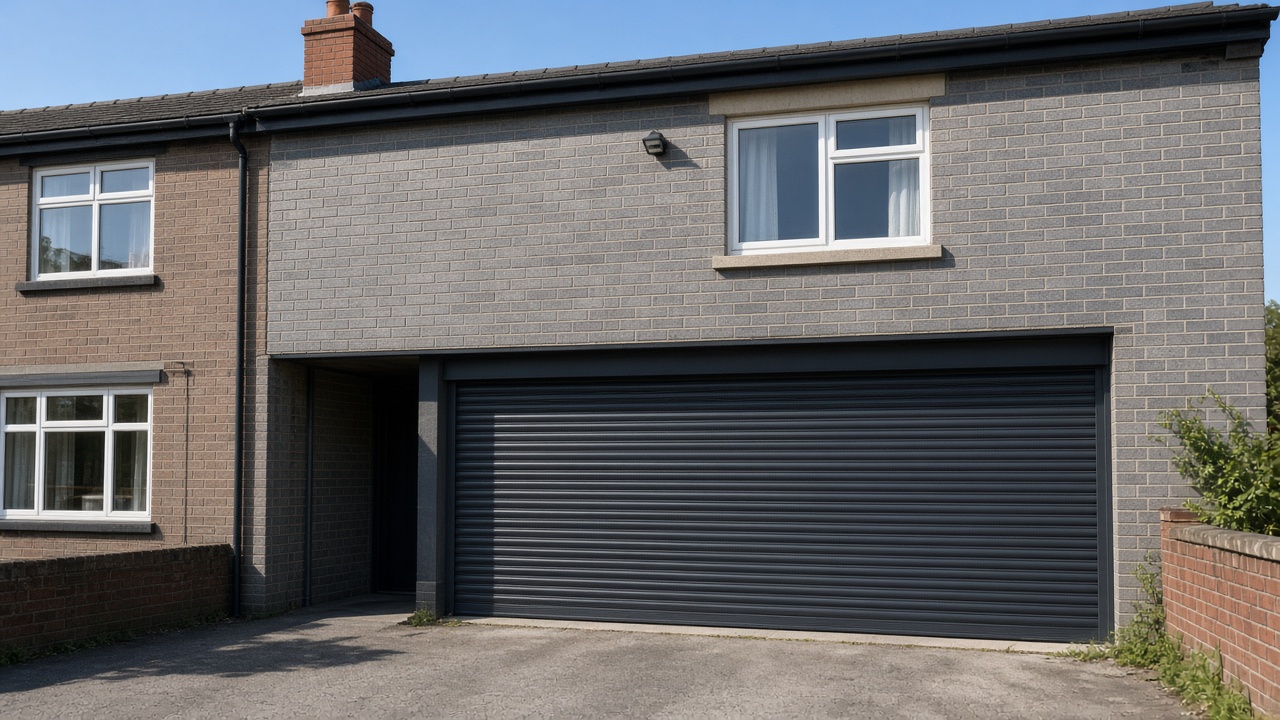
Bifold doors take two kinds of shutter: an external roller shutter that drops outside the glass from a box above the doors, or tracked plantation shutters that hang inside from a top track and fold to one side. Choose the roller for sun heat and night security, and the tracked plantation shutter for privacy and light control. Both need a survey of the handles, the door stack and the space above the doors, and most single roller curtains we checked top out between about 3.3 m and 4 m wide before a mid guide is needed.
Internal or external: decide by what the doors need
The two products do different jobs, so start with the problem rather than the look. The table compares them on the four things that usually decide a bifold: heat, security, privacy and what happens when you want the doors open.
| Need | Tracked plantation shutter (inside) | External roller shutter (outside) |
|---|---|---|
| Sun heat on south or west glass | Weak: it sits behind the glass, so the heat is already in the room | Strong: the curtain stops the sun before it reaches the glass |
| Night security | Little: timber or composite panels inside the room | A real layer when locked down; how much depends on the slat, guides and any certification |
| Privacy and light control | Strong: tilt the louvres for light and privacy at the same time | All or nothing: down is dark, part way down leaves a gap at the bottom |
| Using the doors open | Panels fold into a stack at one or both ends, which covers some glass | Curtain rolls into the box above, but a mid guide on a wide run stands in the opening |
| Handles | The track frame must sit in front of the deepest handle | Guides and bottom bar sit outside, clear of indoor handles |
| Space it needs | Room beside the opening for the stack, and a solid fixing above the doors | Clear wall or soffit above the doors for the box: 165 mm to 205 mm high on one maker's range for doors up to about 2.2 m |
If the room overheats and the doors are also the easy way in, the external roller is the one that does both. If the problem is neighbours looking in, glare on a screen or the look of the room, tracked plantation shutters do that better and need no change outside. Some households fit both. For the internal option in detail, read plantation shutters on bifold doors; for the fitted service, see bifold and patio door shutters.
What makers publish on width
Both products have published limits, and the width of your doors decides more than any brochure photo. On the inside, the limit is the width of each panel. Chichester Shutters, a UK fitter, says tracked shutter panels have a width limit of 660 mm, which gives a maximum opening of 2,640 mm with 4 panels, 3,960 mm with 6, 5,280 mm with 8 and 7,920 mm with 12, and the panels fold in pairs so the count is always even. S:CRAFT's Fiji specification (2019) gives the same 660 mm for multi fold panels on a top and bottom track, and 550 mm for multi fold panels hung from a top track only, with no more than 4 panels.
On the outside, the limit is the curtain. Alutech publishes maximum curtain widths for its roll formed aluminium profiles by wind load class under EN 13659: its PD/39(N) slat runs to 2.9 m in class 1 and only 1.5 m in class 6, its PD/45(N) to 3.3 m in class 1, and its PD/55m(N) to 4.0 m in class 1 and 2.0 m in class 6. Roche Security's T55 insulated aluminium shutter datasheet gives a maximum width of 3,600 mm and a maximum area of 10 m². heroal's RS 55 SL slat page lists a maximum width of 5,000 mm and 12 m², though the same page quotes a smaller width in its introduction, so ask the fabricator which applies.
| Opening | Tracked plantation shutter | External roller shutter, single curtain |
|---|---|---|
| 2.4 m | 4 panels of 600 mm on a top and bottom track; too wide for a top track only on the Fiji limits (4 x 550 mm = 2.2 m) | Within all the profiles above in wind classes 1 and 2; the 39 mm slat is too narrow from class 3 |
| 3.0 m (about 6.3 m² of curtain) | 6 panels of 500 mm; 4 panels would each be 750 mm, over the 660 mm limit | Too wide for the 39 mm slat; the 45 mm slat in wind class 1 only; the 55 mm slat up to class 3; within the T55 and RS 55 SL limits |
| 4.0 m | 8 panels of 500 mm (6 panels stop at 3.96 m) | Right at the 55 mm slat's class 1 limit and over the T55's 3.6 m; within the RS 55 SL table figure; plan for a mid guide unless the profile is rated for your wind class |
| 4.5 m x 2.2 m (about 9.9 m²) | 8 panels of about 560 mm | Over every profile above except the RS 55 SL table figure; usually two curtains with a mid guide |
Two more figures matter on doors. Chichester Shutters says most tracked panels need a horizontal rail once they are taller than 1,981 mm, and S:CRAFT's Fiji specification uses the same height, so a 2.1 m bifold gets a mid rail across its shutter panels. On the outside, wind class cuts the width a profile can span, which is why a rear extension between two side walls can need a split curtain at a width that would be fine on a sheltered plot. Where to put that split is worked through in roller shutters for wide openings.
These are published maximums for named products, checked on 28 November 2026. Your fabricator's own tables for the exact slat, height and wind exposure are what count, so ask to see them on the survey.
Stacking and handle clearance
Inside, the track frame sits in front of the doors. Chichester Shutters puts that frame at about 100 mm wide and says it has to be fitted in front of any protruding door handle, so in a recess shallower than about 100 mm the frame stands proud of the wall. Long D handles push it further into the room. Measure the deepest handle with the doors closed and again with them folded, because a folded bifold can stick out further than a closed one.
Then count the stacks. The doors fold into a stack, and so do the shutter panels. S:CRAFT describes its bi-fold shutters as folding back to the end of the track at 90 or 180 degrees, and Shuttercraft says panels can fold fully to the side. Put the shutter stack at the opposite end to the door stack, or split the shutter so half folds each way, and you keep more of the view. Thomas Sanderson says its tracked shutters can be fitted without a bottom track, which matters where a bottom guide would be a trip hazard; on the S:CRAFT Fiji limits a top track only system stops at 4 panels of 550 mm, so check what your supplier allows at your width.
Outside, the curtain rolls up into the box, so nothing stacks over the glass. The cost is height: Roche lists box sizes of 165 mm to 205 mm for guide heights up to 2,195 mm on its T55, and that box needs clear wall or soffit above the door head. If the run is split, the mid guide is the thing that stands in the open doorway, so line it up with where the doors fold or with a fixed frame.
Why bifolds are the awkward success
The doors fold, so the opening is nearly all glass, and the frame is busy with tracks, hinges and handles. A shutter has to live outside all that machinery. If the guide lands on a track, or the bottom bar hits a handle, the job has failed on day one. The survey measures the doors you have, including any handle you upgraded after the original install.
Width is the other trap. A three-metre opening is a serious curtain. A five-metre opening needs an axle, motor torque and a box that have left the 'spare bedroom window' category. Splitting the run with a mid guide (a vertical track in the middle) can keep the curtain square, at the cost of a line in the view. Take the split if the alternative is a curtain that binds. If you are weighing an internal blind instead, see why internal blinds struggle on a south-facing bifold.
Headroom and the soffit
The cassette (shutter box) sits above the doors. Extension soffits are often tight, full of insulation, downlights and the odd soil-pipe boxing. Check the box height against the space above the doors before ordering: if the headroom isn't there, the choices are a smaller curtain specification, a different product such as a screen with a slimmer head, or not doing it.
Water from the box must be shed, not poured down the cladding. The junction with the existing soffit is a building detail. Fitters who only know how to face-fix onto a flat brick wall shouldn't improvise this on a rendered extension.
Heat, with the doors in real life
You'll want the doors clear when you're in the garden, and covered when the sun is on the glass and you're inside. That means a motor you'll actually use, not a belt at the far end of a 4 metre track. It also means accepting a darker kitchen when the curtain is down. If that darkness is unacceptable at lunch, price a zip screen (fabric in side tracks) or an external venetian instead, and keep the security question for the hours after dark.
The lantern stays a problem. Sit in the room at noon in June and notice whether the heat is on your face from the roof or on your knees from the doors. Buy the shade for the pane that's actually hurting.
Security on the same doors
These doors are the way in. A shutter that locks down at night is a fair security layer on top of decent door locks for the daytime. Specify the bottom bar and the guides with that in mind, and don't cover an escape route with a motor that has no override. A foam thermal curtain and an extruded (solid aluminium) security curtain shouldn't be blurred together to make the sale.
Wind between the houses
Rear extensions often sit in a canyon between two-storey side walls. Wind loads on a wide curtain aren't the same as on a small window in a sheltered estate. Ask for the wind class (the wind rating) rather than assuming a domestic slat is universal. A curtain that billows will damage its own locks, then rattle until you leave it up for good.
What the quote must show
One drawing showing the doors, handles, tracks, guides, box and soffit, with the lantern marked as excluded or as its own line. Also the motor brand, the slat profile, the colour, and who manufactures. A price that just says 'bifold shutter' and a width isn't comparable with anything.
Lead time is weeks, because this curtain isn't sitting on a shelf. If the rear is visible and sensitive, be wary of a deposit that covers manufacture before you've checked planning. A made to measure curtain is usually not returnable, so a deposit spent on manufacture before planning is settled can be lost.
Handles, tracks and the stack
Fold the doors fully before you trust the measure. The stack takes space, and the handles stick out further than the frame drawing suggests, especially if you changed them for longer ones. The guide and the curtain path have to miss all of that. A shutter designed from the original brochure and fitted to the doors you actually own is a clash you'll notice every single time you go into the garden.
The bottom bar has to meet a sill that's often a track and a threshold ramp. Gaps under the bar mean draughts and an easy purchase for a lever. If the sill can't give the bar a fair meeting, say so and change the detail, or accept that this door is a poor shutter candidate.
Width, axle and a possible split
Somewhere past three metres the curtain stops being a big window and becomes a door-sized engineering problem: torque, deflection, box size. A mid guide (a vertical track in the middle of the opening) splits the view and saves the mechanism. In a family kitchen the visual bar is annoying for a week, while a binding curtain is annoying for a decade. Prefer the split when the fitter's face says the single span is brave.
Wind between side walls loads a wide curtain more than a small window on a sheltered estate. Ask what happens in a gale. A half-down curtain is the one that bends. Fully up, or fully down and locked, is the normal storm state for a roller that was specified for the site.
Living with it down
A solid curtain on a bifold turns the nicest room in the house into an evening room at noon. Some households are glad of the dark and the cool. Some will raise it immediately and then find they've bought a box. If you're in the second group, price a zip screen or an external venetian for the hours you're awake, and keep a harder shutter in the conversation only if night security is a separate need you still mean.
You can also shade the fixed panes and leave the doors, or shade only the doors. Draw both. The all-or-nothing package is a sales shape, not a law of glass.
Frequently asked questions
Can every bifold take a shutter?
No. Corner openings, missing headroom and handles that collide with the curtain are real stoppers. A straight rear run with room for a box is the usual yes.
Will it cover the roof lantern too?
No. The lantern is roof glass, so price it separately.
Is a screen better?
A zip screen is better if you need the view and the wind policy suits the garden. A shutter is better if you need blackout and a harder night-time skin.
Should I put shutters inside or outside my bifold doors?
Outside if the problem is sun heat or night security, because an external roller stops the sun before the glass and locks down over the doors. Inside if the problem is privacy, glare or the look of the room, because tracked plantation louvres tilt for light and privacy and need no change to the outside.
How wide can a shutter on bifold doors be?
Tracked plantation shutters can cover very wide openings by adding panels: one UK fitter limits each panel to 660 mm, which reaches 3,960 mm with 6 panels and 5,280 mm with 8. A single external roller curtain is more limited: the aluminium profiles we checked top out between 2.9 m and 5 m, and less in higher wind classes, so wide runs are often split with a mid guide.
Will tracked shutters clear my bifold door handles?
Only if the track frame sits in front of the deepest handle. One UK fitter puts the frame at about 100 mm wide, so in a shallow recess it will stand proud of the wall. Measure the handles with the doors closed and folded.
Sources and further reading
- Chichester Shutters: wide bi-folding doors with top tracks (660 mm panel limit, maximum opening widths, rail over 1,981 mm, 100 mm track frame in front of handles), checked 28 Nov 2026
- S:CRAFT: Fiji specifications 2019 (panel size limits for multi fold shutters with top and bottom track or top track only, bi-fold folding at 90 or 180 degrees, mid rail over 1,981 mm), checked 28 Nov 2026
- Thomas Sanderson: tracked shutters (fitted without a bottom track), checked 28 Nov 2026
- Shuttercraft: the beauty of bi-fold (90 or 180 fold, panels folding to the side, mid rail on larger openings), checked 28 Nov 2026
- Alutech: PD/39(N) roll formed aluminium profile, maximum curtain width and area by wind load class (EN 13659), checked 28 Nov 2026
- Alutech: PD/45(N) roll formed aluminium profile, maximum curtain width and area by wind load class, checked 28 Nov 2026
- Alutech: PD/55m(N) roll formed aluminium profile, maximum curtain width and area by wind load class, checked 28 Nov 2026
- Roche Security: T55 insulated aluminium security shutter technical datasheet (3,600 mm, 10 m², box sizes by guide height), checked 28 Nov 2026
- heroal: RS 55 SL roller shutter slat (maximum width 5,000 mm and 12 m² in its table), checked 28 Nov 2026
- ES-SO, European Solar Shading Organization
- Planning Portal
- GOV.UK: building regulations
- Somfy: solar-powered window roller shutters