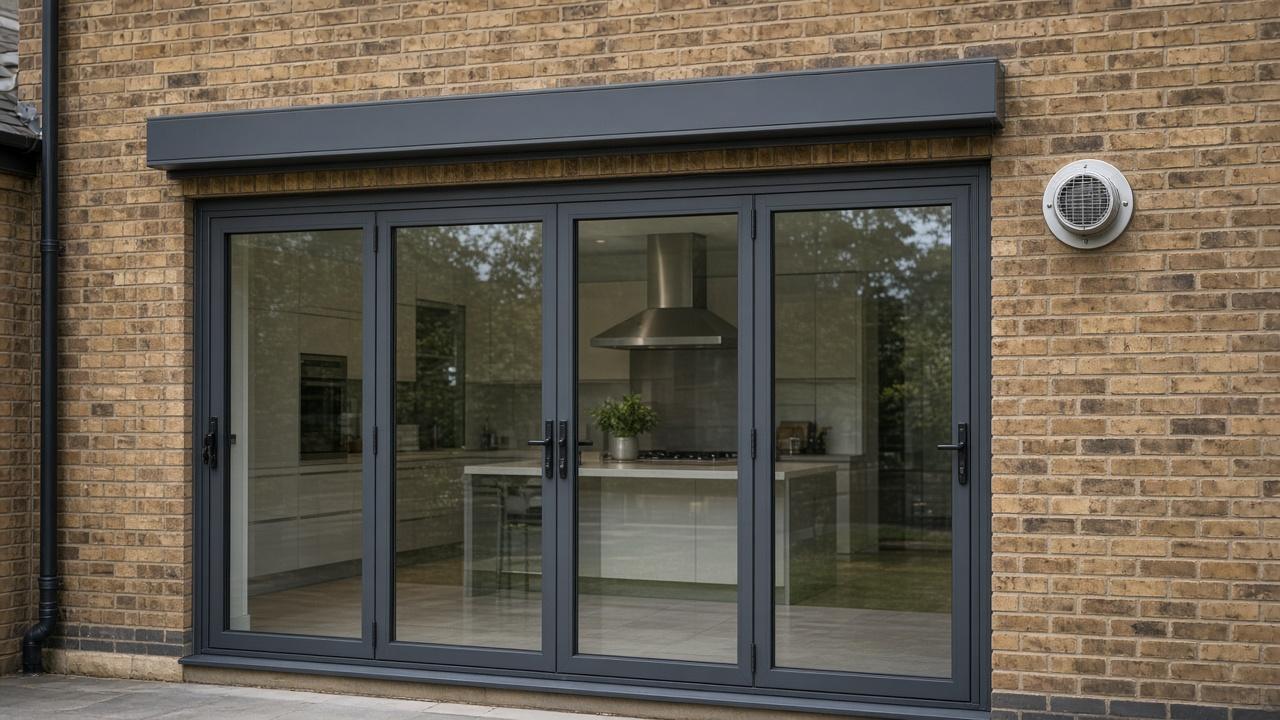
An external shutter box sits outside the glass, so it doesn't steal the clearance above a hob. The fight starts when the extractor duct, a flue or a bulkhead occupies the same band of wall as the cassette (the housing the shutter rolls into), or when the head of the opening is too low for both the hood and a shutter guide.
Inside the room, outside the wall
People picture the cassette dropping into the kitchen and hitting the hood. On a front-mounted shutter, the box is on the outside face. The hood, splashback and wall cupboards stay where they are. You don't lose 150 mm of internal ceiling height because you bought a shutter, unless the installer is proposing a new lintel (the beam over the opening) or a bulkhead to hide a top-mounted box.
Top-mounted boxes, the ones that sit on a new window frame and project into the room, are the ones that meet the hood. If you're replacing the doors at the same time, look at that section before you pick the hood. A canopy hood and a cassette in the same 400 mm is a drawing problem, not something you want to discover when the doors arrive.
The duct through the brick
The usual clash is a 150 mm duct leaving the wall above the bifold, exactly where a front-mounted box wants a clear band of brick. The duct can sit above the box, if there's height, or move to one side, if the run inside the cupboard allows it. It can't pass through the cassette. A fitter who offers to notch the box lid around a flue is offering you a leak and a warranty argument.
Recirculating hoods avoid the duct and avoid this clash, though they don't avoid a bulkhead. If the kitchen design already shows a false ceiling to hide the duct, measure from the underside of that bulkhead to the head of the doors. That gap is what a top-mounted system has to live in. The outside brick is a different measurement.
What to take to the survey
A photo of the outside above the doors, including any grille, boiler flue or overflow, and a photo of the hood inside. Mark the grille on the outside photo. Fitters miss a cream grille on a cream wall, and then spend the install morning arguing with a Gas Safe engineer.
If the hood isn't bought yet, leave a note saying the duct position is free. It's much easier to exit the duct to one side of a 4 metre shutter than to move a shutter axle that's already been built.
Height of the opening itself
A hood that's already tight to the head of a bifold is a door problem, not a shutter problem. Building regulations and the hood maker both care about clearance over the hob, and a shutter guide doesn't change the hob. What it can change is a door company wanting to drop the frame to make room for a top-mounted box. That drop is what collides with the hood. Ask for the frame height before and after the box, in millimetres, on the same drawing as the hood.
If you're keeping the existing doors and only adding a front-mounted shutter, measure the outside brick band and ignore the hood unless a duct comes through. Write that assumption on the quote, so a later 'we need to move the hood' is a change, not a surprise buried in 'subject to survey'.
Frequently asked questions
Will the shutter stop the hood extracting?
Only if the outlet grille is covered by the curtain or the box. A grille above the cassette, clear of the slats, still exhausts. Check that with the curtain fully down.
Can the duct go through the box?
No. Move the duct or move the box. A hole in the cassette isn't a detail.
Does a recirculating hood change the shutter?
It takes the outside grille out of the problem. You still have to fit the box on the brick and, if the box is top-mounted, under the bulkhead.