Old openings are rarely square. A shutter is made to one width and one height. If you measure once, in the middle, the curtain will bind where the opening is tight and leave a gap where it isn't. The manufacturing size is the smallest clear width and the smallest clear height, after the guides and the box have somewhere to land.
Three widths, not a compromise
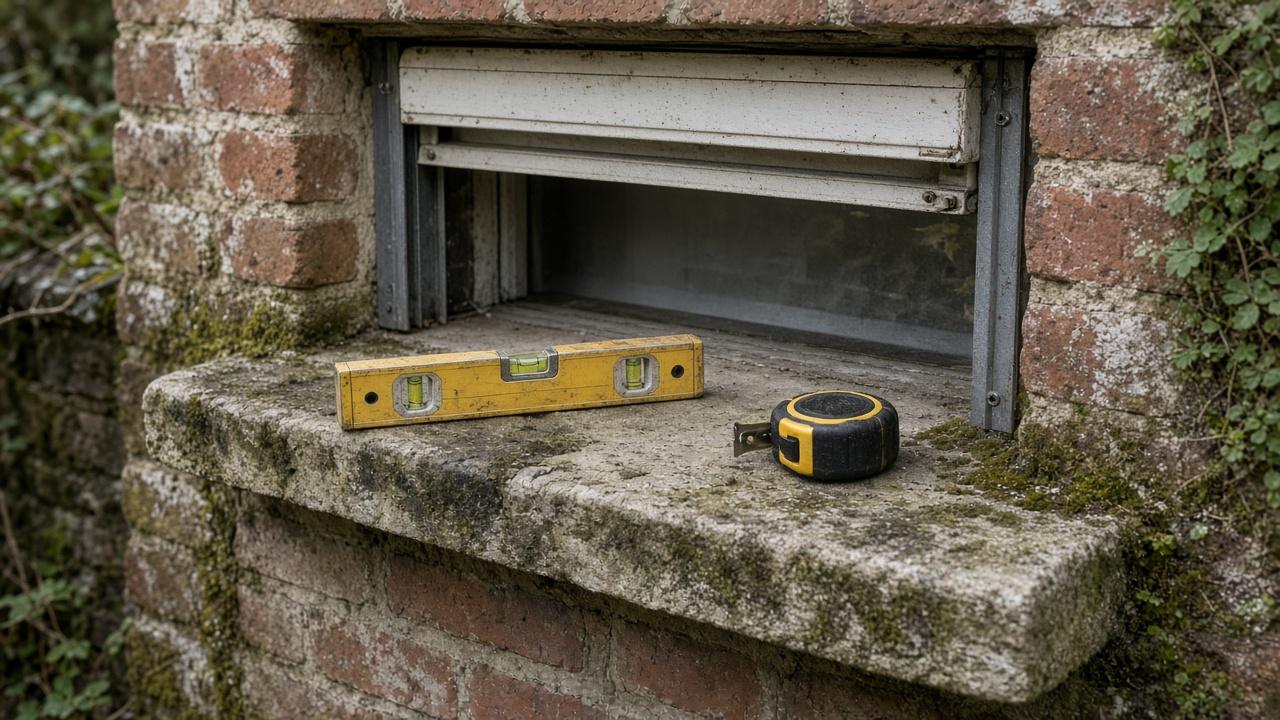
Take the width at the sill, at mid height, and under the head, between the faces the guides will actually touch. Write all three down. The factory doesn't want the average. Average a 1480 mm sill and a 1510 mm head and you get a curtain that fits neither. The tight figure, minus the guide allowance the maker specifies, is the curtain width.
Height works the same way. A sill that falls 15 mm across a bifold means one end of the bottom bar hits early. You can pack a guide, or you can accept a daylight gap at the high end, but you can't get a perfect seal on a falling sill without a bottom bar that follows the sill, and domestic shutters are straight. Say which end will have the gap.
What the guides eat
The clear opening between bricks isn't the curtain width. Guides have a thickness, and they need a landing on the frame or on the reveal (the recess around the opening). On a uPVC door the landing may be the outer frame rather than the brick, because the brick reveal is splayed. Measure the landing, then ask the maker how much each guide consumes. Two guides at 50 mm is 100 mm you don't get to put slats in.
Handles and locks that project into the reveal steal more. A bifold handle that sticks out 40 mm will meet the slats if you measured to the glass. Open the door, measure to the handle, and decide whether the guide sits beside the handle or the handle has to change.
Why two quotes disagree
One firm measured the brick. One measured the frame. One deducted for guides and one sold you the 'opening size' as if the curtain floats. Those three numbers can be 80 mm apart on a door that looks simple. Ask each quote to state the manufacturing width, the manufacturing height, and what they deducted. If they won't, you don't have a price you can compare.
A survey from photos will guess the square. That's fine for a budget, but it's a bad way to cut aluminium. Pay for the tape, or accept that the second visit is where the real size appears and the price moves.
Out of square on the height as well
Walls lean. A reveal that's plumb at the sill and 10 mm out at the head means the guide, which is straight, will stand off the wall at one end. Packing is normal. Packing of 20 mm, hidden behind a guide on a rendered wall, is a finishing problem and sometimes a sign you're forcing a shutter onto a pier that should have been rebuilt. Note the lean on the survey in millimetres, not as 'a bit out'.
Two openings that look like a pair often aren't the same size. Measure both. Order 'two the same as the first' and the second curtain will bind. The second opening only counts as the cheaper line on a quote when the tape says it matches.
Frequently asked questions
Should I send the largest measurement?
No. The curtain has to pass the tightest point. The largest measurement is how you order something that won't go into the opening.
Can the bottom bar be made to a slope?
Ordinary domestic curtains are rectangular. A falling sill is dealt with by the limit and by accepting a small gap, not by bending the bottom bar.
Is a laser measure enough?
A laser is fine if you still take the three positions and the guide landing. One click at mid height is the same mistake as using a tape once.