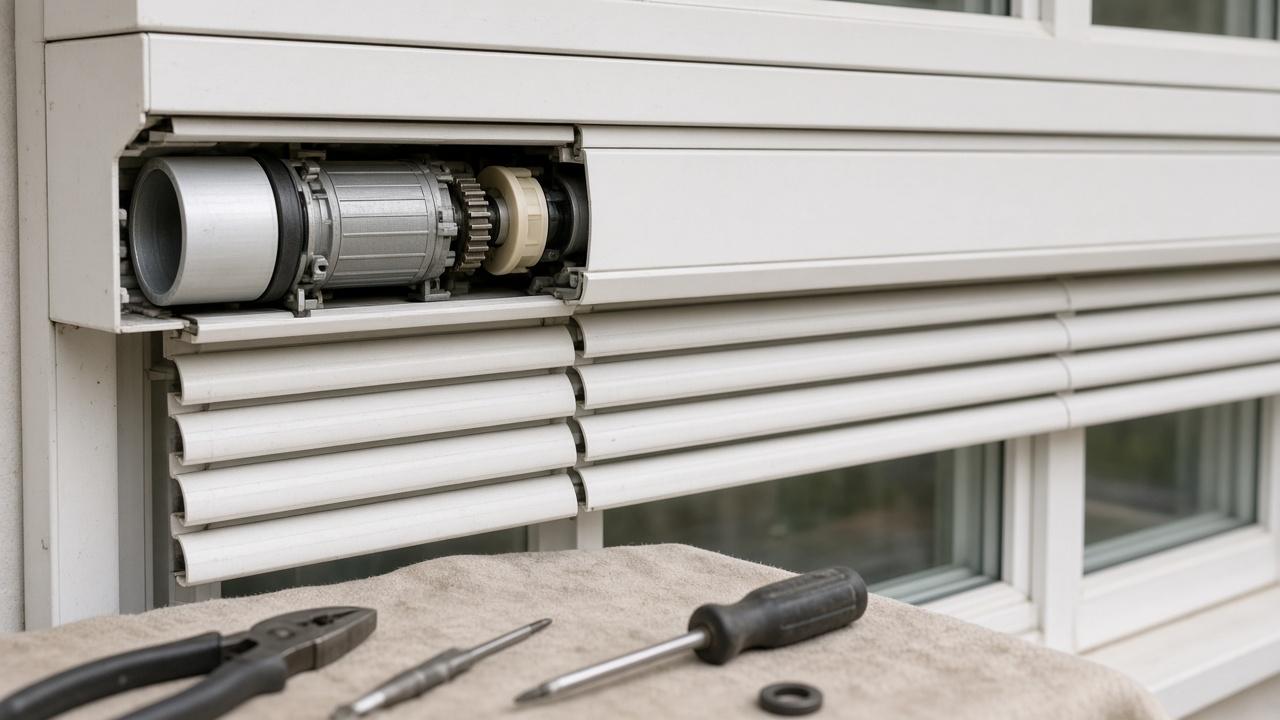
When a roller shutter stops, the part that's died is often the tube motor inside the axle, not the slats. A like-for-like motor can go back into the same curtain (the rolling shutter) if the axle, locks and guides are still straight. That's a smaller job than a new shutter, though it's still electrical work.
How to tell it is the motor
A curtain that used to run and now only clicks, or runs for a second and stops, is often a motor, a limit, or a thermal cut-out (the motor protecting itself after too many button presses). A curtain that's walked sideways and jammed in the guide is a mechanical fault, and a new motor will jam in the same place. Look at the slats before you buy a drive.
Solar shutters add a battery and a panel. If the panel is painted over, shaded by a new porch, or unplugged inside the box, the motor is innocent. Check the charge and connections first. A wired motor with a dead supply is the same story: breaker, fuse and switch first, then the tube.
What has to match
Domestic tubes are commonly a set diameter, and the motor has to slide into that tube and drive it through the crown and the wheel (the drive fittings at the end of the axle). The adaptor isn't universal. A star-shaped drive and a round drive don't swap just because the torque number on the box looks similar. The useful note is the brand label, which is sometimes only readable once the box lid is off. Photograph it.
Limits have to be taught again after the swap. The old motor's stopping points don't live in the curtain. The new one has to be set so the bottom bar meets the sill and the slats close fully into the box. A motor that's strong enough on paper can still be the wrong length for the axle, and then the curtain won't sit square.
The electrical half
A wired motor that's already on a fused spur, swapped for the same sort of motor, is a replacement on an existing circuit. It still wants isolation, a test, and someone who's allowed to do that work. Changing from a belt to a new wired motor, or adding a new circuit back to the board, is a different job and can be notifiable electrical work (work the building-control scheme expects to hear about). Solar avoids the new circuit, but it doesn't avoid the need to get the polarity and limit direction right.
Radio handsets are paired to the motor, not to the curtain. A new motor usually means teaching the remote again. If you've got a wall switch and two handsets, budget for a visit long enough to pair all of them, not just the one the fitter has in their pocket.
When the curtain should go as well
Split slats, pulled-out end locks, a tube that's dropped inside the box, or guides bent from a forced curtain will wreck a new motor in a season. In that case the right quote is a new curtain on the existing guides, or a full replacement if the guides were drilled into a frame you're about to change.
Ask for the motor model and tube type in writing on the invoice. The next failure, years on, is much shorter to sort out if that line is in the house file. A price that only says 'shutter repair' is how people pay twice.
Frequently asked questions
Can any motor go in any shutter?
No. Diameter, crown, drive shape and length have to match the axle. The label in the box is the starting point.
Will my old remote still work?
Only after it's paired to the new motor. Bring every handset and the wall switch to the visit.
Is this notifiable electrical work?
A like-for-like swap on an existing safe circuit often isn't a new circuit. A new cable back to the consumer unit can be. Ask the electrician, and keep the certificate if one is issued.