 Local Shutter Installers
Motors · Long note
Retrofitting solar roller shutters on UK brick
Updated
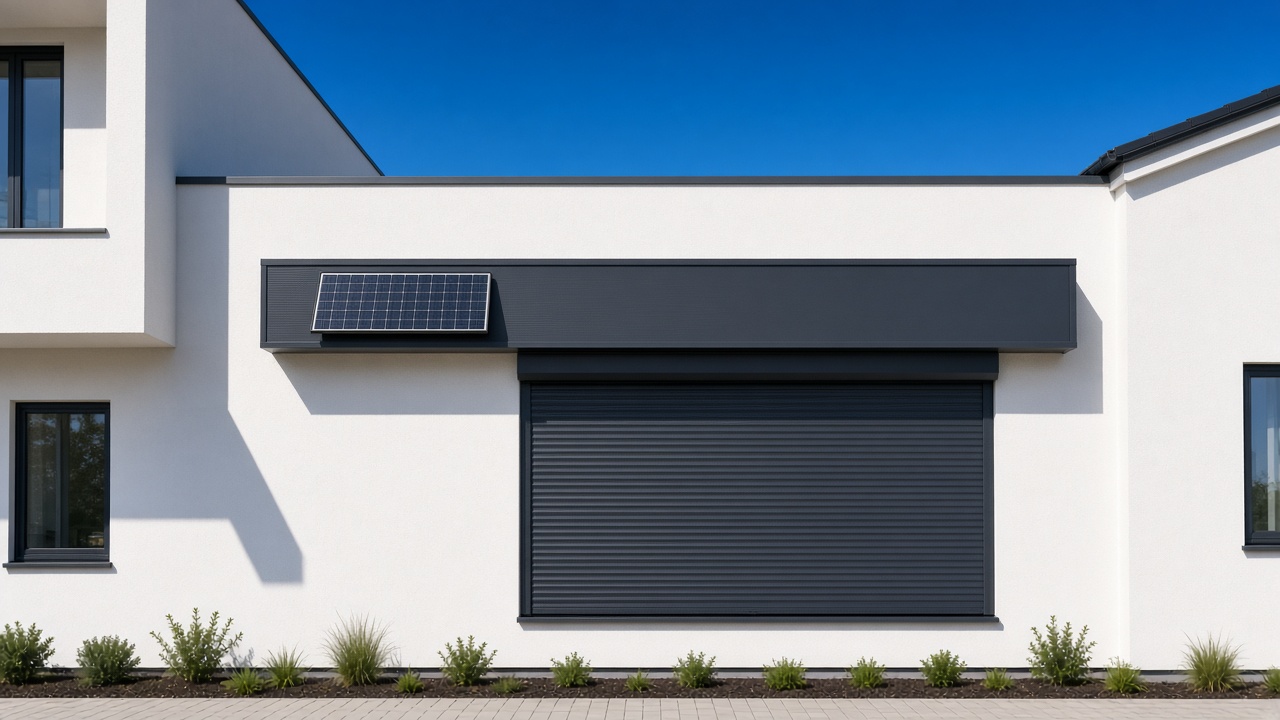
A solar roller shutter puts the panel, the battery and the motor in the external box, so a finished brick wall does not need a new cable back to the consumer unit. It is a good retrofit when the box can see daylight. It is the wrong drive when the panel would live in permanent shade.
What is actually solar
The curtain is still a made-to-measure aluminium shutter. The solar part is the drive: a small photovoltaic panel, usually on the front of the cassette, a battery, and a tube motor in the axle. Somfy publishes this as a domestic retrofit that stays outside and does not need a connection to the house wiring. Bubendorff builds the shutter and the drive as one product and describes itself as a solar specialist, with manufacture in France and Germany.
You are not running the house off that panel. You are running a motor that moves a few times a day. The energy demand is small, which is why makers can claim dull-day charging. The claim still assumes the panel is not painted, buried under a soffit, or facing a wall a metre away.
Why brick walls like this version
A wired motor wants a cable. On a cavity wall the tempting route is a drill straight through, which can wet the cavity, hit a tray, or leave a draught and a cold spot for the sake of one switch. Doing it properly means a designed penetration, a sleeve, and often an electrician. Solar skips that hole. On a decorated finished house, that is the point.
The guides and the box are still fixed to the outside. You have not escaped the measure, the colour decision, or the question of whether the elevation can wear a cassette. Solar is an electrical simplification. It is not a planning exemption and it is not a lighter box.
Winter, Scotland, and north walls
A panel with an open view of a bright sky can keep a shutter battery topped up through a British winter because the motor is thrifty. A panel on a north elevation under a deep eaves, or behind a dense tree, may not. Aberdeen is a sterner test than Southampton. The honest survey stands at the proposed panel in the worst month and says yes or offers a wired motor.
Snow sitting on a flat panel, or a new porch added later, will also stop the charging. None of this is exotic. It is the same common sense you would use for a cheap garden light, applied to a door you might need to open.
If the battery is flat and you need the door
Ask this before you buy, not during a power cut. Some systems can be opened manually and some cannot. A rear door that is the everyday way into the garden cannot become a sealed lid. Escape routes must not depend on a charged battery. If the shutter covers a door from a room you sleep in, treat the override as part of the specification.
Battery replacement is a maintenance item, years out, and someone has to be able to reach it without destroying the reveal. Note the maker and the model in the house file. 'Solar shutter' is not a parts reference.
Who made the curtain
With Somfy, the motor brand and the shutter maker are often different companies. The fitter should say who fabricated the curtain and who warrants the drive. With Bubendorff the public offer is a single maker, sold through a dealer. Either can be right. A dealer fitting the product for the first time, on your expensive bifold, is the risk you can choose not to fund.
Controls should include a switch or a simple handset you will not lose, plus a timer if dusk closing is the winter benefit. An app alone is a hobby. Radio protocols differ. Write down the one you are buying so the next motor can match.
A sensible order of work
Survey the openings and the sky. Decide whether planning or a freeholder has to speak before manufacture. Only then freeze sizes and colours. Fitting a single easy window can be a short visit once the shutter exists. The weeks are in the making and in any consent, not in the last afternoon on site.
Pay attention to water at the top of the box and at the guide fixings. A solar retrofit that stains the brick underneath has failed in the ordinary way, electrics aside. A drip detail is cheaper on day one.
The hole you are not drilling
A cavity wall is a rain jacket with a gap. A casual hole for a motor cable can bridge that gap, drip into the insulation, or nick a tray above a window. Solar drives are popular because they leave that risk on the table. The brackets and the guides are still fixed outside, with plugs that suit brick or block, and the top of the box still needs to shed water. You have simplified the electrician, not the weather.
If the house is mid-rewire anyway, a wired motor can be the cleaner machine, with a switch back to the consumer unit on a route the electrician is already opening. Do not pay a solar premium out of doctrine. Pay it when the decorations are finished and the sky is kind.
What 'works in winter' has to mean
The motor moves a curtain a handful of times a day. That is a small battery job, which is why dull daylight can be enough. It is not enough if a porch roof, a neighbour's extension or a dense evergreen puts the panel in shade for the short days. Ask the surveyor to photograph the panel position and to say, in a sentence, whether they would wire this one instead.
Snow on a flat panel, or paint from a later fascia job, will also stop it. The handover note should say 'do not paint the little panel' in plain words. It sounds silly until a decorator does exactly that.
Service in year seven
Batteries age. Tube motors fail less often than straps, and they still fail. The question is whether a person with the right part can reach the axle without destroying the reveal. Note the diameter and the brand. If the curtain maker and the motor maker differ, note both, and note which local firm actually fitted it.
A lost handset should be a pairing visit, not a new shutter. That is only true if someone kept the programming method. Put the leaflet in the same folder as the boiler's, not in a kitchen drawer that gets emptied.
What I would put on the drawing for Retrofitting solar roller shutters on UK brick
A plan of the rear, a section through the head, the box projection, the guide face, and the lantern marked as excluded if the shutter cannot see it. The stand-in house is in London. Borough design guides, Article 4 directions and leasehold walls stop more jobs than the price of the motor. A flat almost never owns the outside face of the building. Colour as a RAL or a frame foil, looked at in daylight, not a phone photo taken after rain.
Sizes at three heights. 2.4 by 2.35 metres is only the illustration inside Retrofitting solar roller shutters on UK brick, so the drawing of the real house replaces it. If two firms disagree, do not average the tapes. Watch one of them measure again.
Sun and the night, on that drawing
The worked opening for Retrofitting solar roller shutters on UK brick is 2.4 m wide by 2.35 m high, 5.64 square metres of glass. This figure puts 495 watts per square metre on the pane and uses a g-value of 0.76, about 2122 watts into the room if the curtain is up. An opaque external shutter, taken as stopping 90 percent of that gain while it is fully down, leaves about 212 watts and keeps about 1910 watts out. That is a noon figure for comparison. An internal blind does not get the same reduction. For Retrofitting solar roller shutters on UK brick, use the noon figure to compare two openings on the same house, then let a measured survey replace the figure.
Winter figure for Retrofitting solar roller shutters on UK brick: glass at 2.6 W/m2K, 5.64 square metres, a 12 degree inside-outside gap and eight night hours. The bare pane is about 1.41 kWh a night on that crude sum. A closed shutter cutting about 30 percent of the flow leaves 0.99 kWh and saves about 0.42 kWh a night, only while it is down. Open it when you want winter sun.
A closed curtain on a January night is doing thermal work on single-glazed bays and on tired double glazing. It is not a substitute for sorting the sash. Use the product in both seasons or admit you bought a summer gadget. Retrofitting solar roller shutters on UK brick is a poor purchase if the curtain will live in the box from September.
Money, exclusions, and the neighbour's Munich photo
Fitted illustration for Retrofitting solar roller shutters on UK brick in London: £3,565 at September 2026 prices, for this 2.4 by 2.35 m opening with a solar motor. The figure allows a front-mounted aluminium curtain and ordinary fixing. It does not include scaffold, a rebuilt soffit, planning drawings, or a new window. A second opening on the same visit usually costs less than the first, because the van is already there. Compare two quotes only when the slat, the box and the drive match.
The job that proceeds is often a rear bifold or a pair of bedroom windows, solar if the household wants to avoid a new cable through the party wall. Copy the principle of an external curtain, not a postcard of a street whose walls were built around the box. Retrofitting solar roller shutters on UK brick on a British rear extension is often the honest version. Retrofitting solar roller shutters on UK brick on a listed sash front is often the version that should stop.
Stop Retrofitting solar roller shutters on UK brick if the door is an escape route and the motor has no way to open when it is dead. A photograph is not a manufacturing size.
What to do with this note
Retrofitting solar roller shutters on UK brick is a long note because the decision is a pile of smaller ones: which pane, which side of the glass, which box the wall can carry, whether anyone may refuse the look, and whether you will actually lower the curtain. The 2.4 by 2.35 metre example, the solar motor, and the £3,565 illustration are there so those decisions have numbers attached. They are not an order form.
Take the openings that hurt into a survey. Leave the ones that do not. Ask the fitter to repeat the brief in a sentence you recognise. If they cannot, you are being sold a range rather than a remedy. Compare the next quote against the slat, the drive and the exclusions, not against a single bold total.
Keep the summer close and the dusk close as separate habits. Retrofitting solar roller shutters on UK brick fails if the hardware is perfect and the curtain stays in the box. It also fails if you fit it on a front the council will make you remove. The successful version is smaller than a whole-house fantasy and more specific than an advert for German streets.
Questions worth asking the fitter
Does a solar shutter need direct sun?
Makers such as Somfy say daylight is enough, not only hard sun. Deep shade, north soffits and a panel with no sky are still a bad bet. The survey should say which case you are.
Will it run in a power cut?
The motor uses its own battery, so a house power cut does not by itself stop it. A flat shutter battery still can. Ask how you open the door if that happens.
Is there still an electrician?
Not for the motor supply, if the system never ties into the house wiring. You still want a competent fitter for the shutter itself.