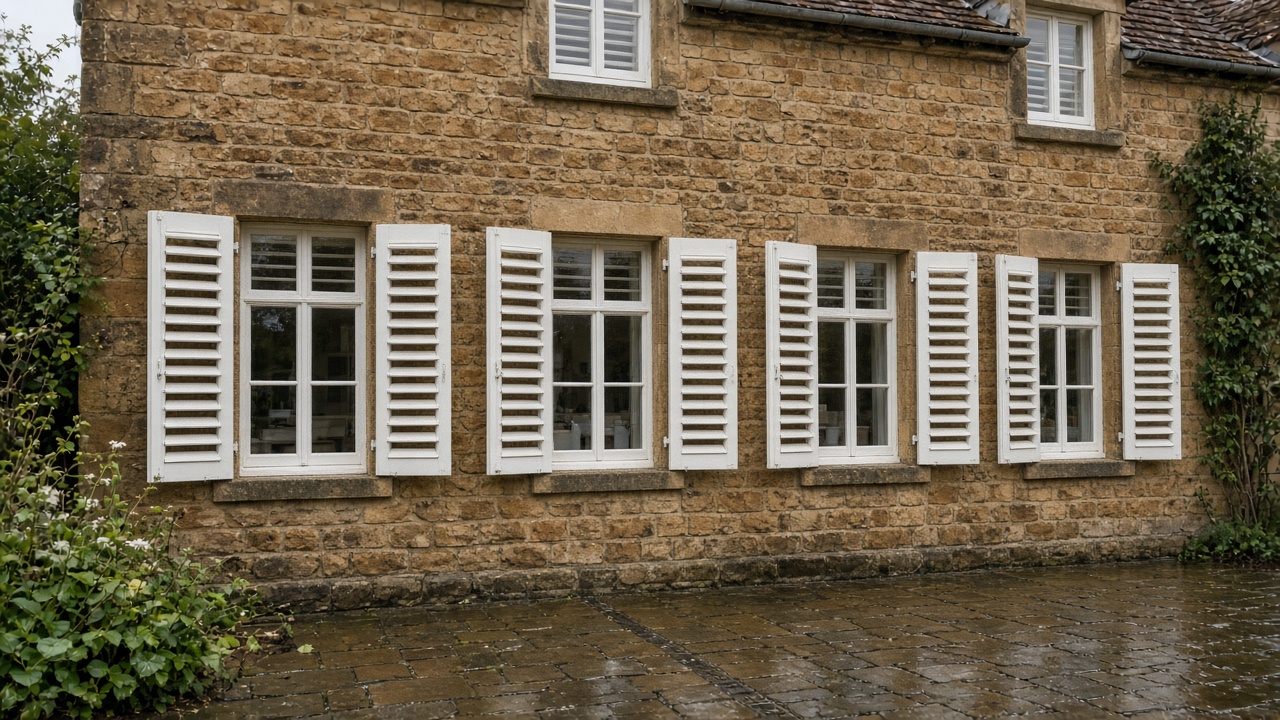
Victorian and Georgian window shutters are timber panelled leaves hinged inside the window reveal that fold back into boxes, called cases in Scotland, when they are open. Many survive painted shut or screwed to their boxes, and freeing and repairing them is usually the first thing to try: Historic Environment Scotland says shutters can cut heat loss through a window by up to 50%. In a listed building, works that affect its character need listed building consent, inside as well as out, so speak to the council before removing or replacing original shutters. Where they have gone, the choice is new joinery shutters made to match, or solid or louvred shutters on a frame in the reveal.
Key points
- Panelled boxes either side of a sash window, deep enough to hold folded leaves, usually mean the shutters were there.
- Look for hinges: Historic Environment Scotland notes some late 19th century panels were only decorative, and no hinges means they never opened.
- Listed building consent covers internal works that affect character. Ask the conservation officer before you remove, alter or replace original shutters.
How to tell if you have original shutters
Look at the sides of the window opening. Where a period house had shutters, the reveal is lined with timber panelling, often splayed outwards into the room, and the panels either side of the sash are deep enough to hold folded leaves. Historic Environment Scotland's INFORM guide on timber window shutters says the boxes hide the leaves so neatly that many householders do not know their property has working shutters.
Look for butt hinges along the inner edge of the panels, a knob on the outer leaf, and brackets on the back that once held an iron shutter bar across the window. If the panels have no hinges at all, they may be decorative: the same guide notes that by the late 19th century some moulded shutters were simply panels, never meant to open.
| Part | What it is |
|---|---|
| Leaves | A pair of panelled sections hinged to the edges of the window, sometimes with a narrower inner leaf to cover the gap in the middle |
| Stiles and rails | Vertical and horizontal frame timbers joined with mortice and tenon joints; the mid rail lines up with the middle of the sash window |
| Case or box | The housing in the reveal that hides the folded leaves |
| Shutter bar | A flat iron stay bar across the window, slotting into brackets on the back of the shutters |
| Latch | A simpler, less secure catch where the leaves meet |
| Hinges | Usually two or three butt hinges per leaf from the late 19th century; earlier H, L, T and butterfly hinges |
| Divided leaves | Occasionally two or three hinged sections, so the bottom can close while the top lets light in |
Restoring shutters that are painted or screwed shut
Historic Environment Scotland's advice is practical. Cut through the paint at the shutter edges with a craft knife and gently prise the leaf open. If it still will not move, look closely for nails or screws a previous owner drove into the box, and withdraw them slowly so the surrounding joinery is not damaged.
Stiff or misaligned leaves are often a hinge problem caused by layers of paint, which can usually be scraped off in place. If a leaf still binds, the wood has probably moved over the years and the edge can be planed down. A blacksmith can make a missing shutter bar.
Take care with paint. Original schemes, including wood graining, may survive on the backs of the leaves, and old layers are likely to contain lead. The guide says shutters should not be dipped in tanks of stripper, which removes the colour from the wood, shrinks and distorts the panels and weakens the glue in the joints.
Listed buildings: what needs consent
Listing covers the interior. In England, section 7 of the Planning (Listed Buildings and Conservation Areas) Act 1990 forbids works to alter a listed building in any way that would affect its character as a building of special architectural or historic interest unless they are authorised. In Wales the same rule has been in section 88 of the Historic Environment (Wales) Act 2023 since 4 November 2024. Section 6 of the Scottish Act of 1997 says the same, and section 7 sets out how consent authorises the works. Historic Scotland's Managing Change guidance on windows names traditional timber shutters among the fixtures that contribute to a window's interest and character, and says the local authority decides whether consent is needed.
Historic England's advice is to check with the council's conservation officer first. There is no fee for listed building consent, but unauthorised work is a criminal offence (section 9 of the 1990 Act in England), and under section 38 the council can serve a notice requiring the building to be put back to its former state. Councils draw the line in slightly different places. Bath and North East Somerset, for example, says releasing shutters that are painted, nailed or screwed shut does not need consent, while replacement shutters do, and should match the originals in style and materials. Do not assume your council takes the same view: ask. Our guide to shutters on listed buildings covers the application itself.
If the originals have gone: three routes
| Route | What it involves | Fits a listed building? | Light control |
|---|---|---|---|
| Reinstate joinery box shutters | A joiner makes new leaves to match surviving joinery in the house or in similar houses nearby; they can be insulated | The route councils tend to favour; consent usually needed | Open or closed, or divided leaves |
| Solid panel shutters on a frame in the reveal | Made to measure panels fitted inside the reveal, closest in look to originals | Case by case; avoid cutting historic joinery | Open or closed only |
| Louvred plantation shutters in the reveal | Full height or tier on tier louvred panels on a frame | Case by case; a less traditional look | Louvres tilt for light and privacy |
Historic Environment Scotland says a joiner should be able to make and fit new shutters to suit the style and period of the house, guided by surviving original joinery and comparable houses nearby. Where the boxes survive, new leaves fold into the space designed for them.
If the boxes have been removed and the reveal plastered, a frame mounted shutter is the practical answer. Solid panels give the nearest look to the originals; see solid panel shutters. On a tall sash, tier on tier louvres let you close the lower half and keep the top open; see shutters for sash windows. Prices for both are in our plantation shutter cost guide.
Why they are worth bringing back
Shutters were built for warmth as well as privacy. Historic Environment Scotland's page on sash window heat loss puts the saving from timber shutters at 51%, against 14% for heavy lined curtains and 63% for secondary glazing, and says secondary glazing combined with blinds and shutters can cut heat loss by more than 75%.
Closed at dusk, a working set also keeps most light out, because the leaf edges are rebated, and the shutter bar adds a layer of security at night. Our guide to closing shutters at dusk sets out the winter routine.
Edinburgh, Glasgow and other Scottish case shutters
In Scotland the boxes are called cases. Historic Environment Scotland traces timber shutters in Scottish houses to the late 17th century. If you live in a period flat with sash and case windows, check the reveals before ordering anything new. Our Edinburgh and Glasgow pages cover local listing and conservation area rules, and planning for shutters in Scotland covers the national position.
Frequently asked questions
What are Victorian box shutters?
Timber panelled leaves hinged inside the window reveal that fold back into panelled boxes, or cases, when open. They were built into many Georgian and Victorian houses.
Can original window shutters be restored?
Usually. Cut through the paint at the edges, remove any nails or screws, clear paint from the hinges and plane down a binding edge. A joiner can repair damaged leaves.
Do I need listed building consent to restore shutters?
It depends on the work and the council. Works that affect a listed building's character need consent. Some councils, such as Bath and North East Somerset, say freeing shutters that are painted shut does not, but replacements do. Ask the conservation officer.
How much heat do internal shutters save?
Historic Environment Scotland puts the saving from timber shutters at 51% of heat loss through a sash window, and its shutter guide says up to 50%.
What should I fit if the original shutters are gone?
New joinery shutters made to match, if the boxes survive. If they do not, solid panel or louvred shutters on a frame inside the reveal.
What is a case shutter?
The Scottish name for a traditional folding shutter. The case is the box in the window reveal that the leaves fold into.
Sources and further reading
- Historic Environment Scotland: INFORM guide, Timber Window Shutters (revised March 2016, first published March 2010), checked 28 Nov 2026
- Historic Environment Scotland: how to reduce heat loss from sash windows (timber shutters 51%, heavy curtains 14%, secondary glazing 63%), checked 28 Nov 2026
- Historic Scotland: Managing Change in the Historic Environment, Windows (October 2010 edition, copy hosted by Aberdeenshire Council), checked 28 Nov 2026
- Planning (Listed Buildings and Conservation Areas) Act 1990, section 7 (restriction on works affecting listed buildings), checked 28 Nov 2026
- Planning (Listed Buildings and Conservation Areas) Act 1990, section 9 (contravening section 7 is an offence), checked 28 Nov 2026
- Planning (Listed Buildings and Conservation Areas) Act 1990, section 38 (listed building enforcement notices, restoring the building to its former state), checked 28 Nov 2026
- Historic Environment (Wales) Act 2023, section 88 (requirement for works to be authorised, in force 4 November 2024), checked 28 Nov 2026
- Planning (Listed Buildings and Conservation Areas) (Scotland) Act 1997, section 6, checked 28 Nov 2026
- Planning (Listed Buildings and Conservation Areas) (Scotland) Act 1997, section 7, checked 28 Nov 2026
- Historic England: Listed Building Consent (no fee, unauthorised work is a criminal offence), checked 28 Nov 2026
- Historic England: Traditional Windows, their care, repair and upgrading (published 8 February 2017, under review), checked 28 Nov 2026
- Bath and North East Somerset Council: sustainable construction and retrofitting SPD, reinstate existing and missing shutters, checked 28 Nov 2026