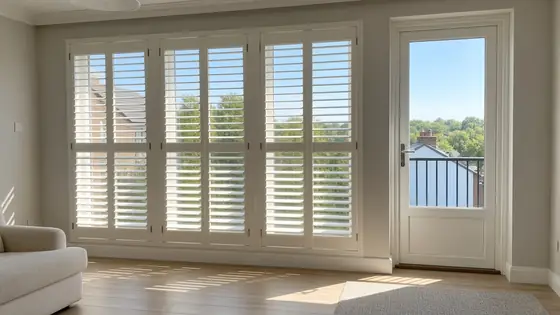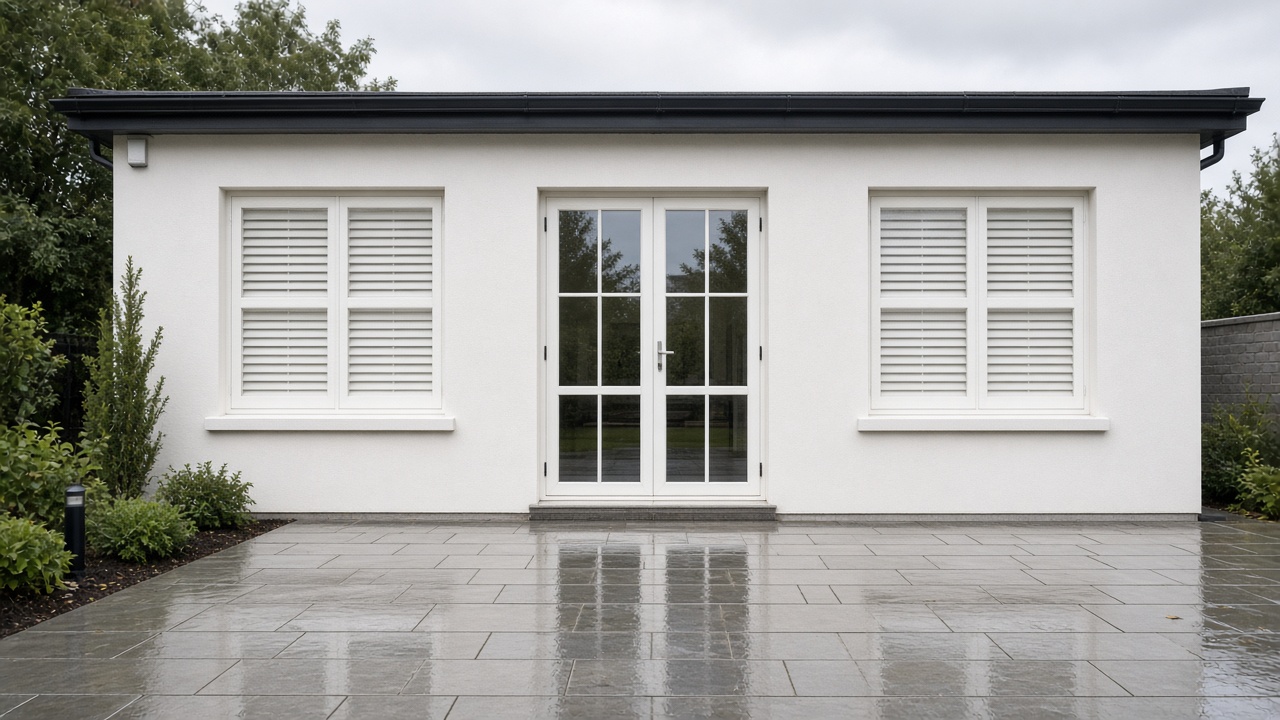
Plantation shutters are made-to-measure panels of wide adjustable louvres fitted inside a window or door frame. You tilt the louvres to control light and privacy, and swing the panels open to clean or open the window. They are also called interior shutters, louvre shutters, wooden shutters or window shutters. The main styles are full height, tier-on-tier, café style and solid panel.
Key points
- Plantation shutters sit inside the room, unlike external roller shutters which sit outside the glass.
- The four main styles are full height, tier-on-tier, café style and solid panel. Tracked versions cover doors.
- Common louvre sizes are 47 mm, 63 mm, 76 mm, 89 mm and 114 mm. Bigger louvres give a clearer view.
- Materials range from MDF and ABS composite to basswood, paulownia and waterproof polymer.
Where the name comes from
The name comes from the large houses of the American South and the Caribbean, where wide louvred shutters let air move through a room while keeping out the sun. Today the term simply means an interior shutter with wide louvres. In the UK you will also hear interior shutters, louvre shutters, wooden window shutters and, less accurately, shutter blinds.
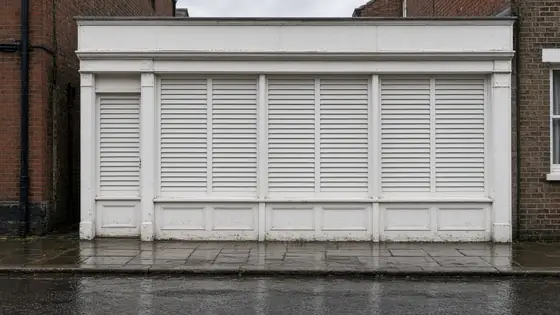
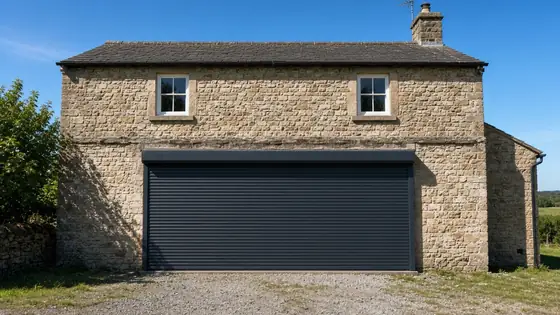
In Britain the word shutter also describes the metal external roller shutters common on German and French houses. They are a completely different product. Our plantation versus external roller comparison explains which does what. For every other kind, inside and out, see our guide to types of window shutters.
The main types of plantation shutter
Many shutters can also have a split tilt rod, which lets the top and bottom louvres in one full height panel tilt separately. It gives some of the benefit of tier-on-tier for less money. Hidden tilt systems, where the rod is on the back edge of the panel, give a cleaner look.
| Style | What it covers | Best for |
|---|---|---|
| Full height | The whole window in one set of panels | Most rooms, the most popular choice |
| Tier-on-tier | Top and bottom panels open independently | Street-facing rooms that want light and privacy |
| Café style | Lower part of the window only | Bathrooms, kitchens, ground floor fronts |
| Solid panel | Whole window, no louvres | Bedrooms wanting more darkness, period homes |
| Tracked | Panels on a track that fold or slide | Bifold, patio and wide French doors |
| Special shapes | Arches, circles, triangles, angled tops | Feature windows, loft gables |
Louvre sizes
Louvre size is the width of each slat. Smaller louvres suit small windows and a more traditional look. Larger louvres give a clearer view out when open and a more contemporary look, but need deeper reveals so they can tilt without hitting the glass or handles.
| Louvre | Look | Typical use |
|---|---|---|
| 47 mm | Traditional, fine | Small windows, cottages |
| 63 mm | Classic | Smaller rooms, shallow reveals |
| 76 mm | Balanced | The most common choice in UK homes |
| 89 mm | Open, modern | Larger windows and bays |
| 114 mm | Very open | Large windows with deep reveals |
Materials
Our guide to shutter materials compares them in depth, including which last longest.
- MDF or ABS composite: the budget option. Heavier, very stable when painted, but not for wet rooms and not ideal for very wide panels.
- Basswood: a lightweight, strong hardwood. The most common mid range shutter material.
- Paulownia: very light hardwood, good for large panels.
- Polymer or PVC: fully waterproof, for bathrooms and kitchens.
- Aluminium reinforced: composite or polymer with an aluminium core for tall panels.
Frames and fitting
Most UK windows are shuttered with an inside mount, where the frame sits within the window reveal. Where the reveal is too shallow for the louvres to tilt, or the window has handles that stick out, the frame is fitted to the wall around the window instead (an outside mount). Bays use a frame with corner posts at each angle. A good fitter will scribe the frame to uneven plaster so there are no big gaps. If you plan to keep curtains as well, mention it at the survey, because the frame type changes how far the pole must stand off the wall; see curtains with shutters.
Plantation shutters are made to order from a site measurement, so the time between measure and fitting is usually several weeks. See how long shutters take.
Plantation shutters compared with blinds and external shutters
| Plantation shutters | Blinds | External roller shutters | |
|---|---|---|---|
| Where fitted | Inside the window | Inside the window | Outside the glass |
| Light control | Adjustable louvres | Up or down, some tilt | Open or closed |
| Heat in summer | Small reduction | Small reduction | Large reduction |
| Blackout | No, unless combined | Blackout fabrics available | Yes |
| Security | None | None | Yes when locked |
| Lifespan | 15 to 20+ years | 5 to 10 years | 20+ years |
| Typical cost per window | £400 to £900 | £80 to £300 | £450 to £1,200 |
Frequently asked questions
What is another name for plantation shutters?
Interior shutters, louvre shutters, wooden window shutters and sometimes shutter blinds. They all mean adjustable louvred panels fitted inside the window.
What is the difference between plantation shutters and normal shutters?
Plantation shutters have wide louvres you can tilt. Traditional solid shutters, often found in Georgian and Victorian houses, have solid panels that fold into boxes beside the window.
Are plantation shutters fitted inside or outside?
Inside the room, either inside the window reveal or on the wall around it. They are not designed for outdoor use.
How long do plantation shutters last?
A good hardwood or polymer shutter commonly lasts 15 to 20 years or more with only occasional hinge adjustment.