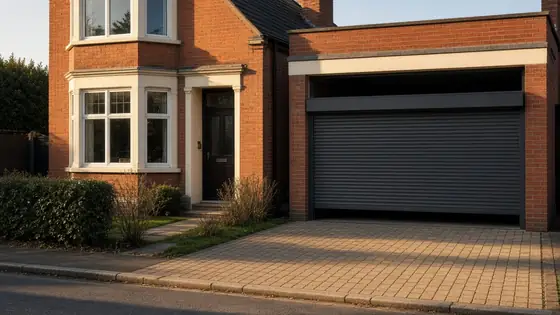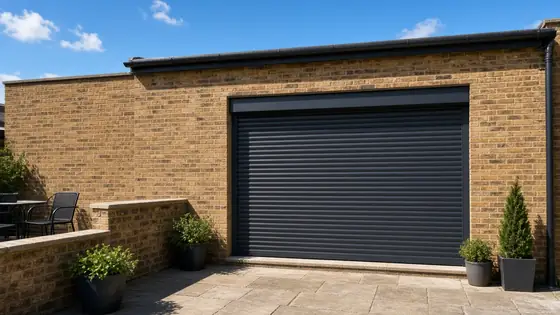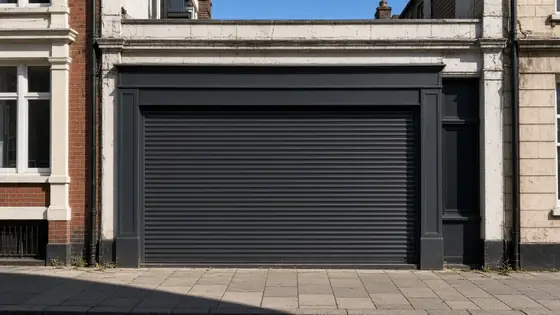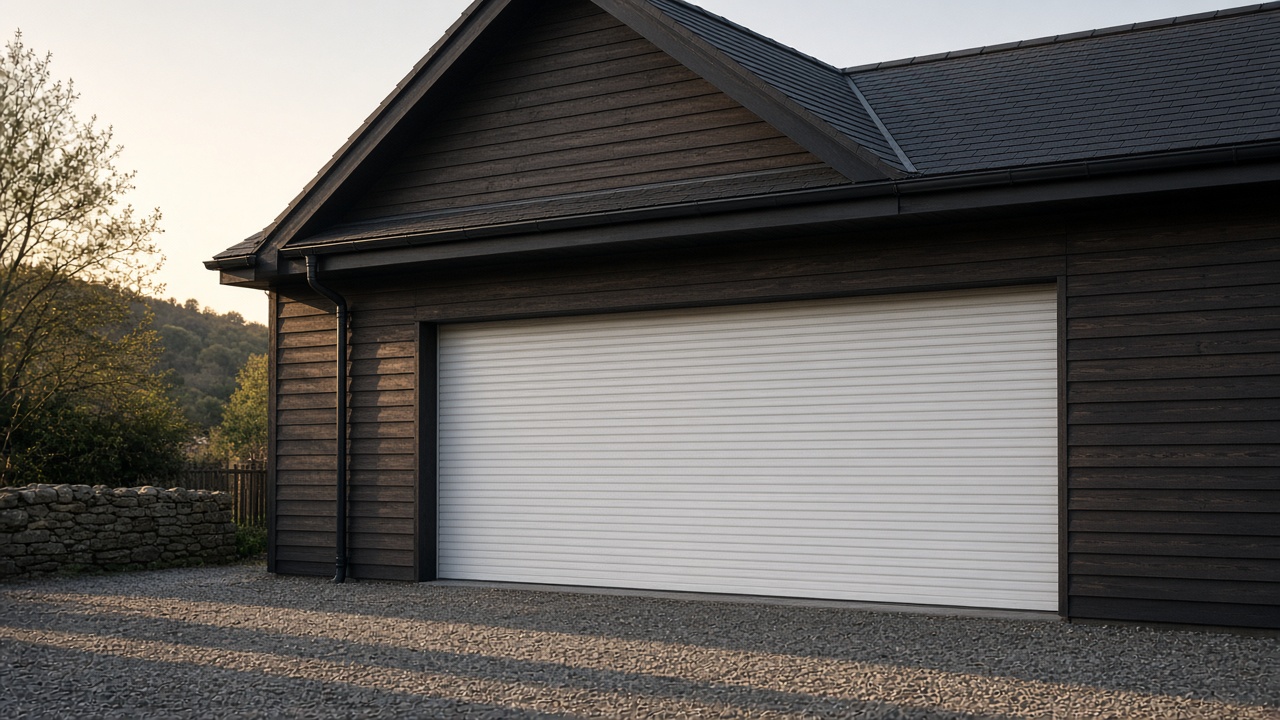
A south-facing patio door gets too hot because the summer sun is high and strong on it through the middle of the day, and the fix that works is shade outside the glass. At noon on midsummer's day the sun is about 62 degrees above the horizon in London and 57 degrees in Edinburgh, but only about 15 and 11 degrees in late December, so a fixed overhang or awning projecting about 1.1 m to 1.35 m over a 2.1 m door can shade it at summer noon and still let most of the low winter sun in. An external roller shutter blocks the sun at any angle while it is down. Internal blinds and plantation shutters help with glare, but Approved Document O does not count internal blinds or curtains when it tests a new home for overheating.
Key points
- Our own calculation: summer noon sun is 57 to 63 degrees high across the UK, winter noon sun only 11 to 16 degrees.
- That gap is why south is the one direction where a fixed overhang or awning works well: it cuts the high summer sun and lets the low winter sun under.
- Over a 2.1 m door in London, an overhang about 1.1 m deep shades the whole door at midsummer noon but only the top 0.3 m at midwinter noon.
- Approved Document O accepts overhangs with a 50 degree cut-off on due south facades. In London the noon sun is above 50 degrees from about 20 April to about 22 August.
- An external shutter works at any sun angle and any time of day. In a measurement programme external sunshades averaged a g-value of 0.3, internal ones 0.6.
- On the site's solar gain method, a 1.8 m by 2.1 m south-facing door takes about 1,480 W of sun at peak, cut to about 220 W with an external shutter down.
Why south is different from east and west
Sun on a south-facing door peaks around solar noon, which in summer is about 1 pm on the clock. That is when the sun is highest. East and west doors take their sun when it is low in the sky in the morning and evening, so it comes straight in under any overhang. Our guide to roller shutters and awnings works through that west-facing case at 6 pm.
South glass also has a winter upside. The sun is low and weak in December, but what there is lands squarely on a south door, and many owners value that free warmth and light. So the best shading for a south door is one that stops the high summer sun without blocking the low winter sun, or one you can raise and lower as the season changes.
How high the noon sun gets, from Plymouth to Edinburgh
The table is our own calculation. At solar noon the sun's altitude is 90 degrees minus your latitude plus the sun's declination. Declination is +23.44 degrees at the June solstice, 0 at the equinoxes and minus 23.44 degrees at the December solstice. The NOAA Global Monitoring Laboratory's solar calculation pages set out the full method; we use the simple noon case. Latitudes are the city coordinates timeanddate.com gives for each place, converted to decimal degrees.
| Place | Latitude | 21 June | March and September equinox | 21 December |
|---|---|---|---|---|
| Plymouth | 50.37° N | 63.1° | 39.6° | 16.2° |
| London | 51.50° N | 61.9° | 38.5° | 15.1° |
| Manchester | 53.48° N | 60.0° | 36.5° | 13.1° |
| Newcastle upon Tyne | 54.98° N | 58.5° | 35.0° | 11.6° |
| Edinburgh | 55.95° N | 57.5° | 34.0° | 10.6° |
As a cross-check, timeanddate.com's tables for 2026 give 61.9 degrees at London's solar noon on 21 June and 15.1 degrees on 21 December, 57.5 degrees for Edinburgh and 63.1 degrees for Plymouth on 21 June, and 13.2 degrees for Manchester and 11.7 degrees for Newcastle on 21 December, all within about 0.1 degree of our figures.
The summer sun does not stay at its peak for long. In London, timeanddate gives a noon altitude of 50.8 degrees on 22 April, 56.4 degrees on 1 August, 52.5 degrees on 15 August and 47.0 degrees on 31 August. Hot spells in late August come with a noticeably lower sun than at midsummer, which matters for the overhang sums below.
What that means for an overhang or awning
A fixed overhang, canopy or open awning casts a shadow down the glass. At solar noon on a south facade, the depth of shadow below the overhang is its projection multiplied by the tangent of the sun's altitude. So a high sun makes a deep shadow and a low sun a shallow one. The table works this for a 2.1 m high door in London with the overhang fixed right at the door head.
| Overhang projection | 21 June (61.9°) | Equinox (38.5°) | 21 December (15.1°) |
|---|---|---|---|
| 0.6 m | Top 1.13 m | Top 0.48 m | Top 0.16 m |
| 1.0 m | Top 1.88 m | Top 0.80 m | Top 0.27 m |
| 1.12 m | Whole door | Top 0.89 m | Top 0.30 m |
| 1.76 m | Whole door | Top 1.40 m | Top 0.47 m |
To shade the full 2.1 m door at midsummer noon, the projection needs to be about 1.12 m in London, 1.07 m in Plymouth and 1.34 m in Edinburgh, where the sun is lower. A 1.12 m overhang in London still lets winter sun onto all but the top 0.3 m of the door at noon in December.
Approved Document O, the overheating rule for new homes in England, gives a stricter yardstick. For new homes in its high risk location, which covers urban and some suburban parts of London, one of its shading options is an overhang with a 50 degree altitude cut-off on due south facades only. Over a 2.1 m door that means a projection of about 1.76 m, and in London it shades the whole door at noon from about 20 April to about 22 August, when timeanddate puts the noon sun above 50 degrees. Approved Document O applies only to new residential buildings, but it is a fair benchmark for an existing house too.
Two cautions. These are noon figures. Earlier and later in the day the sun swings round to the south-east and south-west and drops, so it reaches the glass from the side; a canopy or awning that runs well past each side of the door does better than one cut to the door width. And a retractable awning has to come in when the wind rises.
External shutter, awning, blinds or plantation shutters
Approved Document O lists the shading it accepts for limiting summer solar gain: shutters, external blinds, overhangs and awnings, along with glazing design such as g-value and reveal depth. It then says that although internal blinds and curtains provide some reduction in solar gains, they should not be taken into account when deciding whether its overheating requirement is met. The reason is physical: a blind inside the glass catches sunlight that has already come through and gives much of it back to the room as heat. A measurement programme published through the AIVC found external sunshades averaged a g-value of 0.3, interpane ones 0.5 and internal ones 0.6. ES-SO, the European solar shading body, says roller shutters reduce solar radiation by up to 96 percent when fully down and work on any facade orientation.
Plantation shutters are internal, so on heat they sit with blinds, not with external shutters. They are still good for privacy, glare and looks; our guide to whether plantation shutters keep heat out sets out what they do and do not do. If you already have blinds on the door, why internal blinds struggle on south-facing glass puts numbers on it.
| Option | Summer noon sun | Morning and late afternoon sun | Winter sun | Main drawback |
|---|---|---|---|---|
| Fixed overhang or canopy | Blocks it if deep enough | Partly, from the side | Lets most of it in | Needs a deep projection; fixed all year |
| Retractable awning | Blocks it when out | Partly, from the side | Retract and it is all yours | Must come in when windy |
| External roller shutter | Blocks it when down | Blocks it when down | Raise it by day, lower at night | Darkens the room when down; needs a box and guides |
| Internal blind | Absorbs it inside the room | Same | Raise it | Not counted by Approved Document O for overheating |
| Plantation shutters | Behind the glass, like a blind | Same | Fold them back | Not an external shade |
A worked example with the solar gain calculator
Take a 1.8 m wide by 2.1 m high south-facing patio door in ordinary double glazing. The site's solar gain calculator uses 560 watts per square metre of sun on a south-facing vertical pane, multiplied by the glass g-value, and treats a closed opaque external shutter as stopping 85 percent of that gain. It gives no reduction for internal blinds.
The door is 3.78 m² of glass. At a g-value of 0.7, that is about 1,480 W of solar heat at peak with nothing outside it. With the external shutter down it falls to about 220 W. Over five hours of shading, the calculator puts the heat kept out at about 6.3 kWh. It ignores ventilation and the thermal mass of the room, so read the guide to overheating glass extensions before treating a watt figure as a room temperature.
Choosing for your door
Use the noon table for your nearest city and pick the approach that matches how you use the room.
- If the door faces due south and you want to keep winter sun, a fixed canopy or a retractable awning projecting about 1.1 m to 1.35 m over a 2.1 m door covers the summer noon sun on our figures, with extra width either side for the morning and afternoon.
- If the room overheats in the afternoon as well, or the door faces south-west, an external roller shutter works at every sun angle. Lower it before the room heats up, not after.
- If the room is also cold on winter nights, a closed shutter adds a layer outside the glass after dark. ES-SO says how much that helps depends on the glazing behind it.
- If an external option is not possible, keep internal blinds or plantation shutters for glare and privacy, and do not expect them to stop a room overheating.
Frequently asked questions
Why is my south-facing patio door so hot in summer?
Because the summer sun is high and strong on it for the middle of the day. On the site's solar gain method, a 1.8 m by 2.1 m door in ordinary double glazing takes about 1,480 W of sun at peak.
How high is the sun at noon in the UK?
On our calculation, about 57 to 63 degrees on 21 June from Edinburgh to Plymouth, and about 11 to 16 degrees on 21 December. London is 61.9 degrees in June and 15.1 degrees in December.
How deep should an overhang over a south-facing door be?
To shade a 2.1 m door at midsummer noon, about 1.1 m in London and 1.3 m in Edinburgh on our figures. Approved Document O's 50 degree cut-off option for new homes needs about 1.76 m over the same door.
Will an overhang block winter sun?
Very little at noon. A 1.12 m overhang over a 2.1 m London door shades only the top 0.3 m at noon on 21 December, because the sun is about 15 degrees up.
Are blinds enough for a south-facing patio door?
Usually not for heat. Approved Document O does not count internal blinds or curtains for overheating, and measured internal sunshades averaged a g-value of 0.6 against 0.3 for external ones.
Do plantation shutters keep a south-facing room cool?
They help with glare and privacy, but they are inside the glass, so on heat they behave like a blind rather than an external shutter.
Sources and further reading
- NOAA Global Monitoring Laboratory: solar calculation details (sunrise and sunset method)
- timeanddate.com: solar noon altitude, London, June 2026 (cross-check)
- timeanddate.com: solar noon altitude, London, December 2026 (cross-check)
- timeanddate.com: solar noon altitude, London, April 2026
- timeanddate.com: solar noon altitude, London, August 2026
- timeanddate.com: solar noon altitude, Edinburgh, June 2026 (cross-check)
- timeanddate.com: solar noon altitude, Plymouth, June 2026 (cross-check)
- timeanddate.com: solar noon altitude, Manchester, December 2026 (cross-check)
- timeanddate.com: solar noon altitude, Newcastle upon Tyne, December 2026 (cross-check)
- timeanddate.com: city coordinates for Plymouth (50°22'N), London (51°30'N), Manchester (53°29'N), Newcastle upon Tyne (54°59'N) and Edinburgh (55°57'N), checked 26 Nov 2026
- GOV.UK: Approved Document O frequently asked questions (FAQ 7: the 50 degree overhang cut-off means a due south window is fully shaded when the sun is 50 degrees or higher; Part O applies only to new residential buildings)
- Approved Document O (2021 edition): paragraphs 0.3, 1.9, 2.7 and 2.8 (scope, shading in the high risk location, acceptable shading, internal blinds and curtains)
- AIVC: Outdoor measurements of g-values for external, interpane and internal sunshades (Bulow-Hube and Lundh, 2002)
- ES-SO: roller shutters (reduce solar radiation by up to 96% when fully extended, effective in all facade orientations)
- ES-SO: external roller shutters (insulation effect depends on the glazing behind)