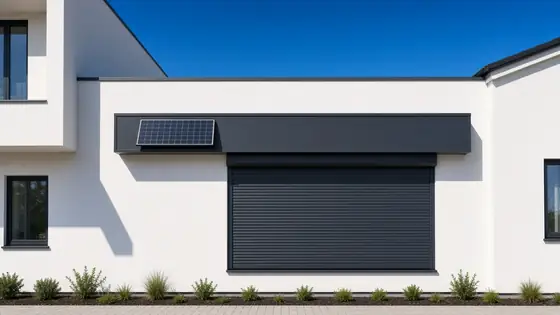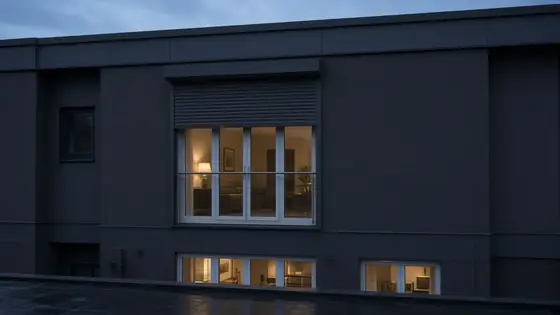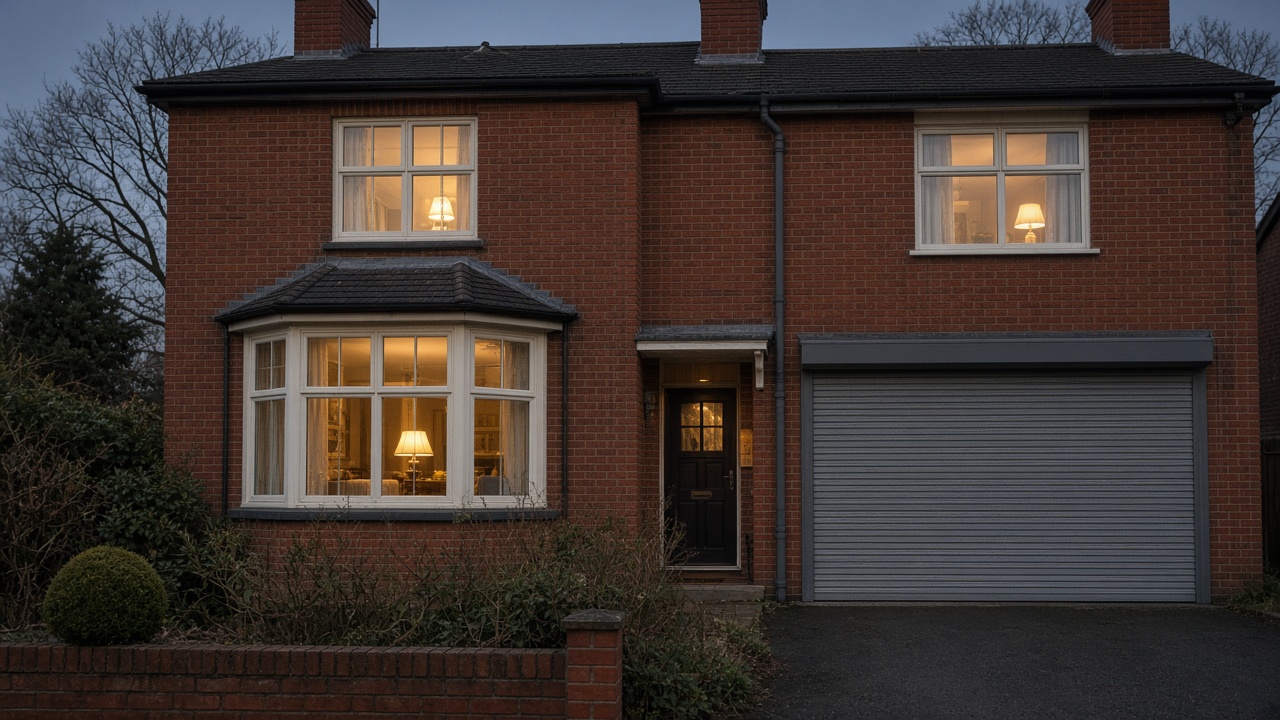
Electric shutters for windows are external roller shutters with a tubular motor hidden inside the axle, so the curtain goes up and down from a switch, remote, timer or app instead of a strap. In the UK in 2026 an electric roller shutter for a standard window typically costs £700 to £1,200 fitted with a mains motor, or £800 to £1,400 with a solar motor, which is £250 to £600 more than a manual shutter. Mains motors run on 230 V and need a proper electrical connection; solar motors charge a battery from a small panel on the box and need no wiring.
Key points
- The drive is the biggest single price difference: a mains motor adds £250 to £450 over manual, a solar motor £350 to £600.
- Mains motors are 230 V. A new circuit is notifiable under Part P in England; a spur from an existing circuit outside a bathroom zone is not, but must still meet BS 7671.
- Solar motors avoid the cable, the hole through the wall and the electrician, but need daylight on the panel.
- Obstacle detection on these motors protects the shutter. Becker says it must not be relied on to protect people.
- Ask how the shutter opens in a power cut, especially over doors.
Electric shutter prices by drive type
Every figure in this table comes from our own published roller shutter price table, which also gives prices for small and large windows, patio doors and bifolds. Smart control is not a separate motor: it is a hub or app added to a radio motor, so price it on top of the mains or solar row. Only one published UK price guide with domestic roller shutter prices loaded when we checked on 26 November 2026: BestBuilders gives £700 to £1,400 for an electric window shutter, which matches our band, and £900 to £1,800 for a 2 m to 3 m patio door shutter, usually electric, which is below our 3 m bifold figures. Our shutter price guide sets out that comparison.
| Drive | Typical price fitted | Extra over manual | Other costs to expect |
|---|---|---|---|
| Manual strap or crank | £450 to £800 | None | None |
| Mains tubular motor (230 V) | £700 to £1,200 | £250 to £450 | Electrician's connection, about £150 to £350 per circuit or fused spur |
| Solar battery motor | £800 to £1,400 | £350 to £600 | Battery replacement after several years, often £80 to £200 for the part |
| Smart or app control | Add to a mains or solar price | Hub or app control £150 to £400 | One hub can run several shutters if the motors share a radio system |
Worked example, four rear windows and a 3 m bifold. Wired: four windows at £700 to £1,200 is £2,800 to £4,800, the bifold is £1,800 to £3,200, and one new circuit from the electrician is £150 to £350, so about £4,750 to £8,350. Solar: four windows at £800 to £1,400 is £3,200 to £5,600 and the bifold is £2,000 to £3,500, so £5,200 to £9,100 with no electrician. Add £150 to £400 to either for app control. On these bands solar costs a little more overall but saves cutting into finished walls; wired wins where the panels would sit in shade.
How electric shutters are powered
| Type | How it works | Best for |
|---|---|---|
| Wired motor | Mains supply, usually through a fused spur or a new circuit | New builds, renovations, shaded walls |
| Solar motor | Panel on the box charges a battery that runs a low voltage motor | Retrofits on finished walls with daylight on the box |
| Rechargeable battery | Battery charged from a plug in charger | Small windows, occasional use; not in our price table, so get it quoted |
Wiring a mains electric shutter: Part P and who can do it
Mains shutter motors run on 230 V. Somfy's installer manual for the ilmo 50 M WT lists 230 V 50 Hz, Becker's instructions for the EVO 20 R give a supply voltage of 230 V AC / 50 Hz, and Simu's product page for its T5S E BHZ motor lists 230V/50HZ. Becker also says that all-pole disconnection from the mains, with a contact gap of at least 3 mm per pole, must be provided when the drive is installed. In a house that is commonly met with a double pole switched fused spur or isolator near the shutter, which also gives the fitter a safe way to switch the motor off for servicing.
In England, Approved Document P (2013 edition) sets out which electrical work in a dwelling is notifiable. Three things are: installing a new circuit, replacing a consumer unit, and any addition or alteration to existing circuits in a special location, which means the zone around a bath or shower, or a room with a swimming pool or sauna heater. Everything else is not notifiable: additions and alterations to existing circuits outside special locations, and replacements, repairs and maintenance anywhere. The document's own example fits shutters well: connecting an electric gate or garage door to an existing isolator switch is not notifiable, but installing a new circuit from the consumer unit to the isolator is.
So a spur taken from a nearby ring circuit to feed one or two window shutters is usually not notifiable, while a dedicated new circuit for a run of shutters is. Non-notifiable work is not a free pass: Approved Document P says it should still be designed, installed, inspected, tested and certificated to BS 7671. For notifiable work the simplest route is an electrician registered with a competent person scheme, who self-certifies the job. The installer or their scheme must give you a Building Regulations compliance certificate and tell building control within 30 days. The alternatives are a registered third-party certifier, or notifying building control before work starts.
The makers say the same thing in their own words. Becker says electrical connections may only be carried out by a qualified electrician, and Somfy says its ilmo motor must be installed by a professional motorisation and home automation installer. Electrical Safety First recommends using a registered electrician and lists the government approved registering bodies, such as NICEIC and NAPIT; a registered electrician gives you a safety certificate for the work. Wales, Scotland and Northern Ireland have their own rules. Our guide to whether you need an electrician for electric shutters goes further into fused spurs and certificates.
What solar motors avoid
Somfy says its solar powered shutters do not need to be connected to your wiring, so there are no holes in the walls: the panel turns light into electricity, stores it in a battery and the motor can run at night. Simu's solar kit for its T3.5 E HZ motor runs on 12 V DC and quotes 45 days of autonomy without sun at two cycles a day. That removes the 230 V connection, the cable through the cavity, the Part P question and the electrician's bill in one go.
What it does not remove is the need for daylight. A panel under a deep north soffit or behind a tree can run the battery flat in winter, and the battery is a part that wears out. Our guide to solar roller shutters on UK brick covers where solar works and where a wired motor is the better machine.
Ways to control them
- Wall switch: simple and reliable, wired or wireless.
- Handheld remote: one channel per shutter or group, plus an all channel.
- Timer: close at dusk and open in the morning automatically. Somfy's TaHoma switch can, for example, open solar shutters at 7 am every morning.
- Sun and wind sensors: close when the sun hits the glass; protect in high wind.
- Smart home hub and app: control from your phone, set scenes and holiday modes, link to voice assistants. Pick the radio system before the motors are ordered; see smart roller shutters.
Safety features worth having
Obstacle and frost detection are built into many electronic motors, and the makers describe them precisely. Somfy says the ilmo 50 M WT has obstacle protection when lowering and anti-freeze protection when raising. Simu says its T5S E BHZ motor stops during closing if it meets an obstacle, and stops during opening if the curtain is stuck in the guide rails by frost. Becker says the EVO 20 R detects a curtain jam on the way down from objects on the sill or sticking guides, then reverses a short way.
Becker is also clear about the limit: its obstruction detection is designed only to protect the shutter from damage, and using it as personal protection is not permitted. Keep children and pets away from a moving curtain whatever the brochure says.
- Obstacle detection: the motor stops if the curtain meets resistance.
- Frost protection: stops the motor straining if the curtain is frozen to the sill or in the guides.
- Manual override or battery backup on any door that is an escape route. See shutters in a power cut.
- Thermal cut out: protects the motor from overheating.
Running costs and lifespan
A shutter motor runs for a few seconds, a couple of times a day. Annual electricity use is a few kWh, costing pennies. Motors commonly last 10 to 15 years or more; solar batteries usually need replacing sooner. See our motor brand comparison and the roller shutter cost guide.
Converting manual shutters to electric
Most belt or crank shutters can be motorised by fitting a tubular motor into the existing axle, typically for £300 to £600 per shutter. Solar conversion kits avoid new wiring. A mains conversion still needs the connection described above, so get the electrician's part priced at the same time.
Frequently asked questions
How much do electric shutters for windows cost?
Typically £700 to £1,200 per standard window fitted with a mains motor, or £800 to £1,400 with a solar motor, in 2026. A 3 m bifold is typically £1,800 to £3,500 with a motor.
Do electric window shutters need an electrician?
Mains motors are 230 V and the makers say the connection should be made by a qualified electrician. In England a new circuit is notifiable under Part P, so use an electrician registered with a competent person scheme. Solar motors need no mains wiring.
Is wiring an electric shutter notifiable under Part P?
Only if it involves a new circuit, a consumer unit replacement, or work on circuits in a bathroom zone or other special location. A spur from an existing circuit elsewhere is not notifiable, but must still meet BS 7671.
What happens to electric shutters in a power cut?
Wired shutters stay where they are unless they have a manual override or battery backup. Solar shutters keep working while the battery has charge.
Can electric shutters be controlled by phone?
Yes, with a compatible hub or app, which our price table puts at £150 to £400. You can set schedules, scenes and holiday modes.
Are electric shutters noisy?
Modern tubular motors are fairly quiet, a low hum for the few seconds they run.
Sources and further reading
- GOV.UK: Approved Document P, electrical safety in dwellings (2013 edition, England), sections 2 and 3 on notifiable work and certification, checked 26 Nov 2026
- Somfy: ilmo 50 M WT installer manual (230 V 50 Hz, obstacle and anti-freeze protection, professional installation), checked 26 Nov 2026
- Becker: EVO 20 R tubular drive assembly and operating instructions (230 V AC / 50 Hz, obstacle detection not for personal protection, qualified electrician, all-pole disconnection), checked 26 Nov 2026
- Simu: T5S E BHZ 230V/50HZ roller shutter motor (obstacle and frost stop), checked 26 Nov 2026
- Simu: T3.5 E HZ 12V motor with solar kit (12 V DC, 45 days autonomy at 2 cycles a day), checked 26 Nov 2026
- BestBuilders: security and roller shutter costs UK (published price guide, indicative prices), checked 26 Nov 2026
- Somfy UK: roller shutters
- Electrical Safety First: find a registered electrician (work to BS 7671 with a safety certificate)