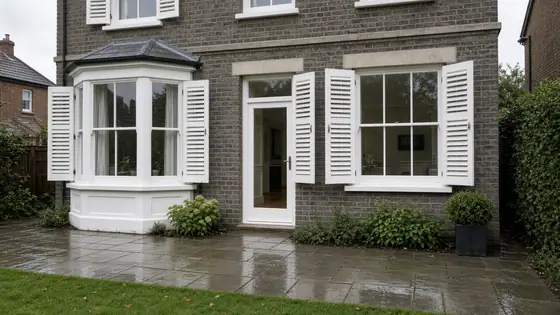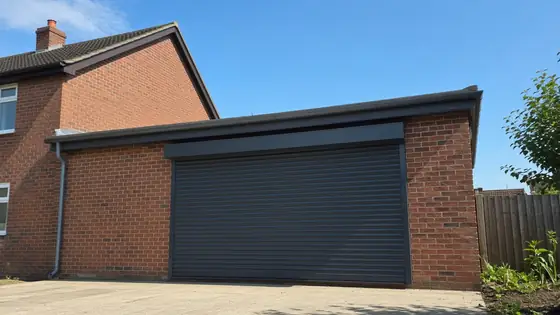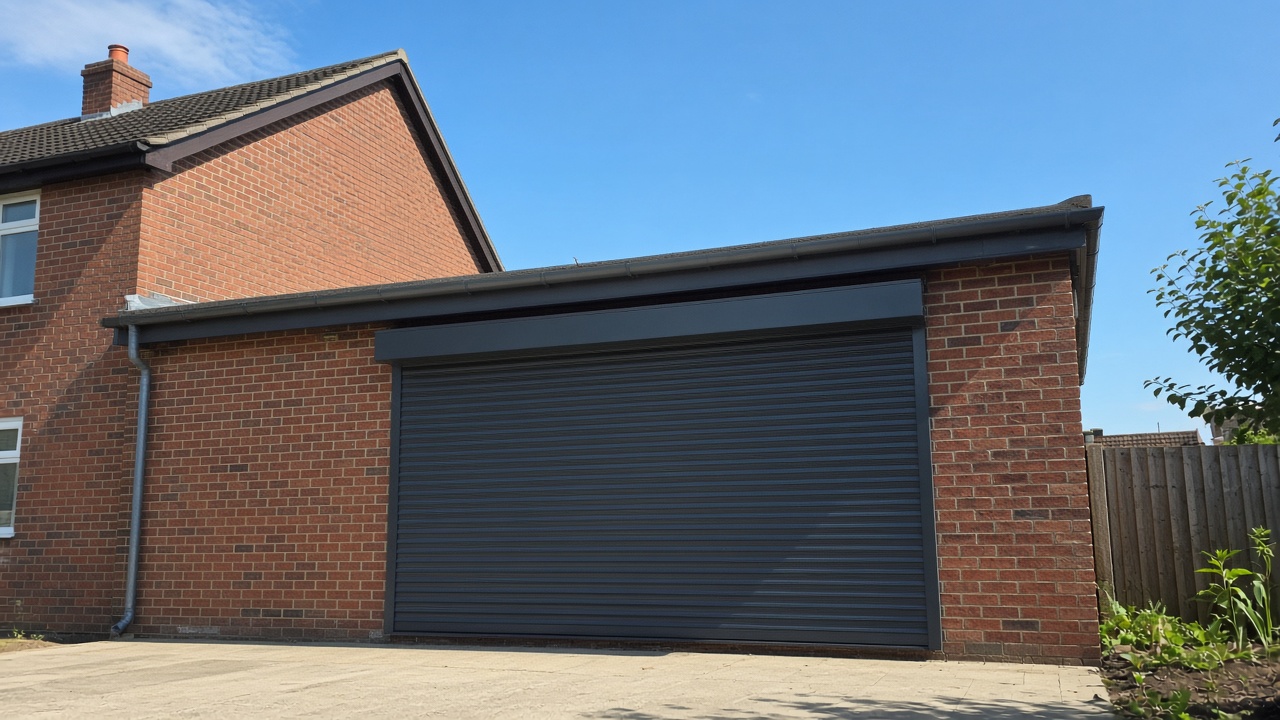
Exterior hinged shutters are leaves fixed on the outside of the house that swing on hinges to cover the window, then fold back flat against the wall. In the UK they come as decorative shutters fixed open, usually composite, or working shutters in timber or aluminium that close and, in aluminium security versions, lock. A working pair needs clear wall either side of the window at least as wide as each leaf, which is half the window: about 60 cm each side on a 1.2 m window. Many terraces and semis do not have that space, which is why so many outdoor shutters here are decorative.
What counts as an exterior hinged shutter
This guide covers shutters on the outside wall that open like doors: louvred, board and batten, solid panel and aluminium security shutters. Shutters that roll down into a box are a different product with their own guide, external roller shutters in the UK. Panels that slide on a track are covered in external sliding shutters, and every type, inside and out, is compared in types of window shutters.
The first decision is whether the shutters will ever close. Decorative shutters are screwed to the wall in the open position and are there for the look. Working shutters hang on hinges, close over the glass and need wall space, solid fixings and a way to hold them open and shut.
Decorative or working: the decision table
Board and batten shutters are vertical boards held by horizontal or diagonal battens, the cottage look. Solid panel shutters are flat or fielded panels with no louvres, the most private when closed; see solid panel shutters for the indoor versions. Louvred shutters let air through when closed. On aluminium security shutters such as the Portchester range sold by Shuttercraft and The Shutter Shop, the louvres still tilt when the panels are locked, so you can lock up and keep air moving.
We do not publish a price band for hinged exterior shutters: we could not find enough independent, dated price sources to meet our evidence rule, so ask for written quotes. For comparison, our own price table puts a manual external roller at £450 to £800 per standard window fitted.
| Type | Closes | Material and finish | What the maker states |
|---|---|---|---|
| Decorative, fixed open | No | Copolymer in louvre, board and panel styles | UK Home Interiors: maintenance free, 40 year manufacturer warranty, up to 15 colours |
| Working timber, louvred or boarded | Yes | Accoya, iroko, Douglas fir, western red cedar or European oak | IQ Glass: hinged or bifolding panels possible, painted or natural, UV protect clear coats |
| Working aluminium security, louvred | Yes, and locks | Extruded aluminium, powder coated | Shuttercraft: locking bolts top and bottom of each panel; The Shutter Shop: lockable from both sides outside |
Sizing: each leaf is half the window
For a pair, each leaf is half the width of the opening, so the two meet in the middle and the closed shutters cover the whole window. Leaves are usually the full height of the opening too. Decorative shutters should be sized the same way, because shutters that could not cover the window if closed look wrong to most eyes.
Measure from the edge of the reveal to the nearest obstruction: the next window, a downpipe, an alarm box, a porch or the party wall line. Wide windows can use bi-folding leaves that fold back on themselves, halving the wall space but doubling the hinges. The Shutter Shop says windows needing more than two panels need a tracking system for its aluminium shutters.
If either side fails the test, decorative shutters fixed open, or a roller, are the options that look right.
| Window width | Each leaf | Clear wall needed each side |
|---|---|---|
| 0.9 m | About 45 cm | About 45 cm plus the holdback |
| 1.2 m | About 60 cm | About 60 cm plus the holdback |
| 1.8 m | About 90 cm, or two leaves each side | About 90 cm, or 45 cm with bi-folding leaves |
Fixings: hinges, pintles and shutter dogs
A working shutter hangs on hinges fixed either to a frame around the window or straight into the wall. Traditional shutters use strap hinges on the face of the leaf that drop onto pintles, pins fixed into the masonry, so a leaf can be lifted off for painting. Aluminium security shutters usually come with their own frame, which is what Shuttercraft's locking bolts engage.
Open shutters need holding back or they slam in wind. Shutter dogs, also called tiebacks or holdbacks, are small pivoting catches fixed to the wall near the bottom of the leaf. Closed shutters need a bar, latch or lock. Every fixing goes into solid masonry, not into render alone. On a listed building, fixings into historic fabric are part of what the consent covers.
Outward opening windows: the common clash
Most UK casement windows open outwards, which exterior shutters were not designed around. Shuttercraft notes that this limits where the shutters can be mounted and that a survey checks the two do not collide. In practice, with the shutters closed you cannot open an outward casement, and with them open the casement must swing clear of the folded leaves.
The fix is to mount the shutter frame outside the window frame so the casement opens inside the shutter line, or to choose shutters only for sash, inward opening or tilt and turn windows. On upper floors you also open and close working shutters by leaning out over the sill, which is one reason a home that wants a shutter closed every night may be better served by a roller worked from inside.
Planning: houses, conservation areas, listed buildings and flats
In England, alterations to a house can be permitted development under Class A of Part 1 of the General Permitted Development Order 2015, with a condition that exterior materials are of similar appearance to the existing house. Whether a set of shutters meets that condition is the council's judgement, so ask before you order, with photos of neighbouring houses that have shutters if you can.
Conservation areas are article 2(3) land under the Order, and councils can make article 4 directions that withdraw permitted development rights, for example on front elevations; GOV.UK guidance says that once a direction applies, a planning application is needed. A listed building needs listed building consent for any works affecting its character, under section 7 of the Listed Buildings Act 1990. Flats have no householder permitted development rights at all: the Order's definition of a dwellinghouse excludes a building containing flats. Our guide to planning permission for external shutters covers each case, including Scotland.
Maintenance by material
Timber shutters need their paint or stain kept intact, especially on the bottom edges and louvre blades where water sits, and repainting more often on south and west walls and near the sea. Lifting leaves off their pintles makes this a bench job. Ask the maker for its coating schedule in writing.
Powder coated aluminium needs washing down and little else; The Shutter Shop describes its aluminium shutters as corrosion resistant and hard wearing. Copolymer decorative shutters are sold as maintenance free. For every type, check once a year that hinges, pintles and shutter dogs are tight in the wall and that nothing is rusting into the brick.
Frequently asked questions
What are hinged exterior shutters?
Shutters fixed to the outside wall that swing on hinges to cover the window and fold back flat against the wall when open.
How wide should exterior shutters be?
Each leaf of a pair should be half the window width, so closed shutters cover the opening. Decorative shutters look right sized the same way.
How much wall space do outside shutters need?
For a pair, clear wall each side at least as wide as one leaf, plus room for the shutter dog or holdback.
Can you get working external shutters in the UK?
Yes, in timber or aluminium, and aluminium security versions lock. They need wall space either side and planning has to allow them.
Do exterior shutters work with outward opening windows?
Only if the shutter frame sits outside the window frame so the casement can swing inside it. With the shutters closed, an outward casement cannot open.
Do outside shutters need planning permission?
Often not on an ordinary house in England, but conservation areas with article 4 directions, listed buildings and all flats need consent.
Are hinged plantation shutters the same as exterior shutters?
No. Plantation shutters are louvred hinged shutters fitted inside the window. See what plantation shutters are.
Sources and further reading
- Shuttercraft: how to select external window shutters (aluminium Portchester, powder coating, locking bolts, outward opening UK windows), checked 29 Nov 2026
- The Shutter Shop: Portchester aluminium shutters (interior or exterior, lockable from both sides, hinged, bi-fold or bypass, tracking over two panels), checked 29 Nov 2026
- IQ Glass: exterior timber shutters (timber species, hinged or bifolding panels), checked 29 Nov 2026
- UK Home Interiors via SpecifiedBy: decorative exterior shutters (copolymer, louvre, board and panel, 40 year warranty), checked 29 Nov 2026
- GPDO 2015, Schedule 2 Part 1 Class A: alterations to a dwellinghouse and the similar appearance condition, checked 29 Nov 2026
- GPDO 2015, article 2: dwellinghouse excludes buildings containing flats; article 2(3) land, checked 29 Nov 2026
- GOV.UK planning guidance: how article 4 directions remove permitted development rights, checked 29 Nov 2026
- Listed Buildings Act 1990, section 7: works affecting a listed building's character need consent, checked 29 Nov 2026
- GOV.UK: permitted development rights for householders, technical guidance, checked 29 Nov 2026