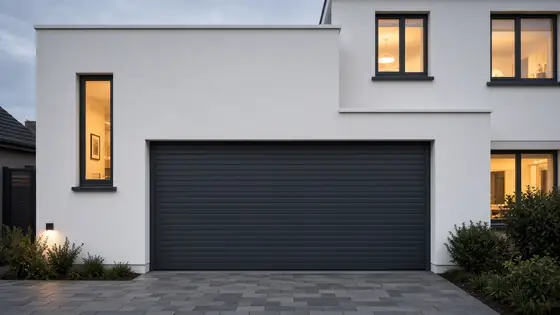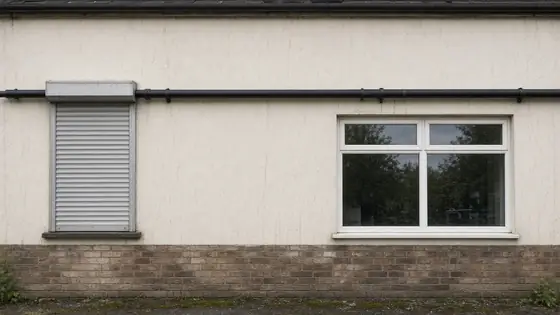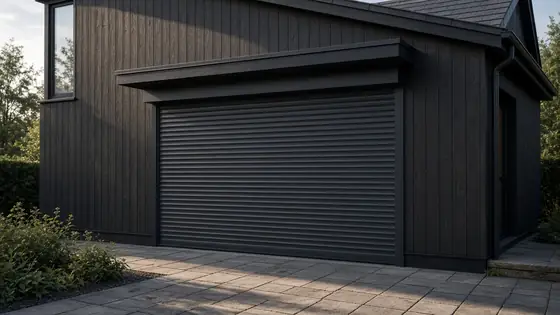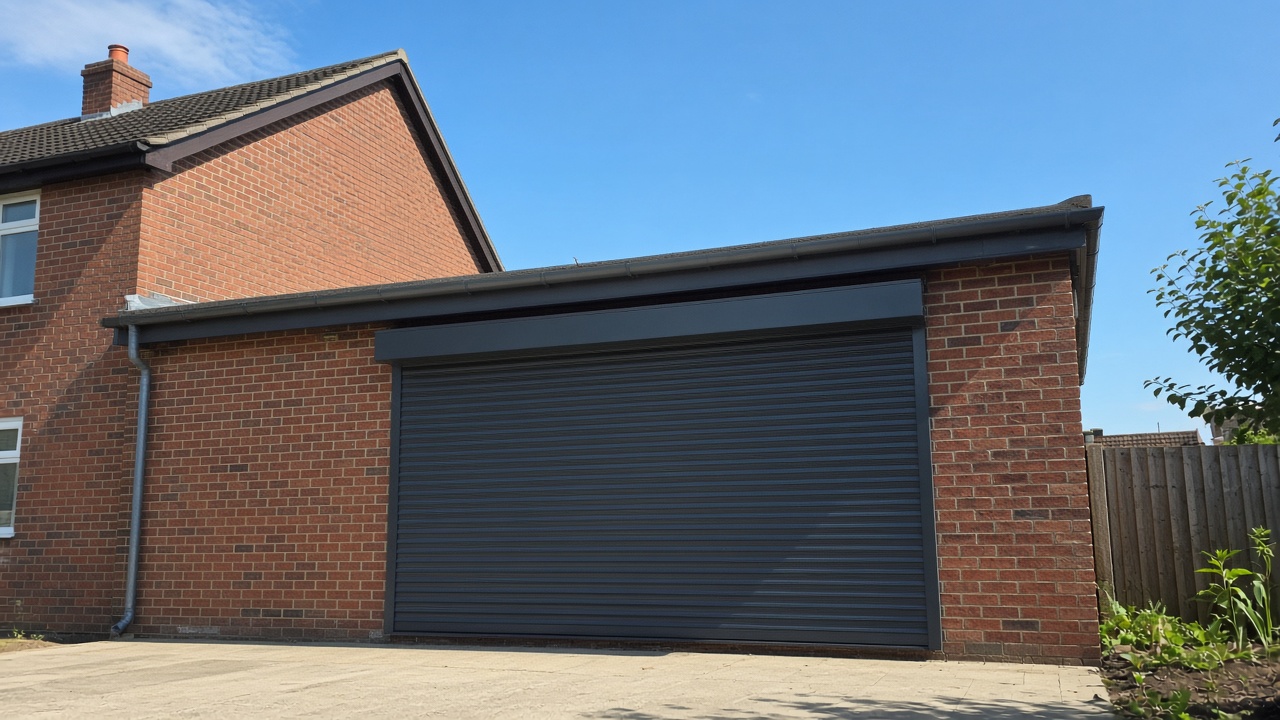
External sliding shutters are rigid panels that hang from a track above the opening and run along a guide at the bottom, parking beside the window or door instead of rolling into a box or swinging on hinges. They suit wide openings, balconies and loggias, modern elevations where the panels are part of the design, and places where there is no room or no wish for a roller box. They need clear wall to one side of the opening (or both) for the panels to park, which rules many terraced fronts out. Most systems sold in Europe are aluminium, with timber slats as an option, and can be manual or motorised. Makers rate them for wind under EN 13659, but we found no sliding shutter on the makers' pages we checked with a published security certificate, so treat them as shade and privacy first.
Key points
- A sliding shutter needs parking space on the wall beside the opening, about as wide as the panels that move. A telescopic system stacks panels and needs less.
- Panels come louvred (fixed or adjustable slats), perforated, expanded metal, fabric or solid. Aluminium is the norm; some makers offer timber slats.
- Wind ratings are given as EN 13659 classes, tested by the method in BS EN 1932. Schenker Storen rates its aluminium sliding and folding sliding shutters to 92 km/h, wind class 6.
- Makers describe locks and stoppers that deter burglars, but none we checked publishes an LPS 1175 or EN 1627 certificate for a sliding shutter. Ask for the certificate if security is the reason you are buying.
- In England, flats have no householder permitted development rights, and conservation areas and article 4 directions can mean an application for a house too. Ask the council before ordering.
Where sliding shutters make sense on a UK house
Sliding shutters are common on continental apartment blocks and new builds, and less so in the UK, where most external shutters are rollers, though UK firms such as Solar-Shield do supply sliding louvre panels for patios, balconies and new build facades. They earn their place in four situations.
Wide openings and glazed walls. Schenker Storen lists its aluminium sliding shutter at up to 2,200 mm wide and 3,000 mm high per panel, and Griesser quotes systems up to 27 m² in total. Several panels on two or three tracks can cover a run of glazing that would need a very large roller curtain.
Balconies and loggias. Griesser describes its Vento range as made for exposed facades and loggias, and BAIER's SLIDETEC system can park its panels on the facade or on the outside of a balcony. On a flat this keeps the shading on the balcony line rather than across each window.
Modern elevations where the shutter is part of the look. A row of perforated or slatted panels reads as cladding when closed and as a feature when open, which a roller box does not.
Openings where a roller box cannot go. A lintel with no depth for a recessed box, a head too low for a front mounted box, or a planning officer who dislikes boxes are all reasons people look at panels on a track instead. Sliding shutters still need a top track, but it is a slim rail, not a box that holds a rolled curtain.
How they work: tracks, guides and parking space
Each panel hangs from carriages that run in a top track fixed under the soffit, to the wall, or to a support panel. At the bottom, a guide keeps the panel in line. Schenker Storen offers a selective guide (fixed at points) or a continuous one; BAIER lists floor guides with stoppers that hold the panel open or closed.
Bypass and telescopic are the two layouts to understand. On a bypass system, panels run on separate parallel tracks and slide past each other. On a telescopic system, the panels are linked so they move together: pull one and the others follow. Schenker says up to three panels can move at once; BAIER offers one to six leaf variants on one, two or three lane wall systems with telescopic synchronous movement. Telescopic layouts cut the parking space needed, because the panels stack on top of each other beside the opening.
Folding sliding shutters are a third option for tighter walls. The leaves fold like an accordion as they run along the rail, so Schenker's version can open to the full width of the window without a large swing. Schenker lists a width of 280 to 600 mm.
| Panel | What it does | Example from a maker's page |
|---|---|---|
| Fixed slats or louvres | Shade and privacy, some light and air through | Schenker fixed slats, Griesser traditional fixed slats, Schüco ALB hollow louvre blades |
| Adjustable slats | Tilt the slats to change light and view | Schenker moving slats, Griesser adjustable slats with ventilation when closed |
| Perforated sheet or expanded metal | Filtered light and a view out, solid look from the street | Griesser 2 mm perforated aluminium sheet, Griesser Sentum expanded metal |
| Solid panel | Most blackout and privacy, no view | Schenker closed model, Griesser Platina 8 mm panel |
| Fabric in a frame | Soft light, lighter panel | Griesser Soltis fabric covering |
| Timber slats | Warmer look; needs more upkeep than aluminium | Griesser wooden rhombus slats |
Manual or motorised
Most systems come both ways. Schüco says its ALB sliding units can be adjusted manually or electrically, with drives that cut off under load. BAIER offers push button and remote control, sensors and house bus links. Griesser offers electric drives worked by app, sensor or timer. Schenker's are worked by button or remote, with smart home links on request and a solar option.
Manual suits a ground floor patio or a balcony you can step onto. A motor makes sense where the panels are heavy, high up, or out of reach behind fixed glazing. As with rollers, a wired motor needs a mains supply and an electrician; see electric shutters for the wiring and control choices, which carry over.
Wind: what the class means
External shutters sold in Europe are classified for wind resistance under EN 13659, using the test method in BS EN 1932:2013, which covers external blinds and shutters fitted in front of windows, doors or facades. heroal states its sliding shutters are tested to the shutter standard; Schenker Storen gives 92 km/h, wind class 6, for both its sliding and folding sliding shutters; Griesser quotes "up to wind resistance class 6 (8)" and says Vento is tested for exposed facades.
Two practical points follow. First, the class belongs to a size and fixing method, so ask the installer which class applies to the panel size and track fixing on your wall, not the brochure maximum. Second, a panel that is half open in a gale catches wind differently from one that is locked shut or parked. Follow the maker's instruction on what to do in high wind. For coastal and hilltop houses, read shutters in high wind before choosing a system.
Security: check the certificate, not the brochure
Sliding shutters can lock. Schenker says its panels can be locked in several ways and deter burglars, and BAIER lists closures and stoppers. That is not the same as a security rating. We could not find a sliding shutter with an LPS 1175 or EN 1627 resistance class certificate on any of the makers' pages we checked. Certified security ratings are more often found on roller shutters.
If security is the main reason for buying, ask the supplier for the test certificate and check LPS 1175 listings on RedBook Live. A panel that can be lifted off its track from outside is a privacy screen, whatever the brochure says. Our guide to external shutters and burglary explains the ratings.
Planning: houses, flats and conservation areas
In England, fitting a shutter to a house can fall under Class A of the General Permitted Development Order 2015, which covers the "enlargement, improvement or other alteration of a dwellinghouse", with a condition that exterior materials look similar to the existing house. A row of aluminium panels and tracks across a brick front may not meet that, and the council decides.
Flats are different. The Order's definition of a dwellinghouse excludes a building containing flats and a flat within one, so householder permitted development does not apply: a shutter on a flat or its balcony normally needs planning permission, and a leasehold flat will also need the freeholder's consent under the lease. In conservation areas, councils can remove permitted development rights with an article 4 direction, and listed buildings need listed building consent for works that affect their character.
Scotland, Wales and Northern Ireland have their own rules. Start with planning permission for external shutters, and for tower blocks see shutters on high rise flats.
Sliding, roller or hinged: which fits your opening
If you want the shutter out of sight when open and worked from indoors on every floor, a roller is usually the simpler answer: see external roller shutters in the UK. If the look is a traditional front and the wall has room either side, read external hinged window shutters. Sliding panels win where the opening is wide, the parking wall is there, and the panels are meant to be seen. For glazed doors at the back of a house, shutters for bifold doors covers the roller and plantation options.
| Sliding panels | Roller shutter | Hinged shutters | |
|---|---|---|---|
| Space needed | Clear wall beside the opening for parked panels | A box above the opening (recessed or front mounted) | Clear wall each side about half the window width |
| Wide openings | Good: several panels on two or three tracks | Good up to the curtain's width limit | Poor beyond a pair or bi-folding leaves |
| Light and view when closed | Louvred, perforated or adjustable panels allow some | Little, unless light slots are specified | Louvred leaves allow some |
| Operated from inside | Only with a motor | Yes, by belt, crank or motor | No, you lean out |
| Published security ratings | None found on makers' pages we checked | Available on some systems | Not usual |
| Look | Modern facade element | Box and guides visible | Traditional |
Getting a price
We do not publish a price range for sliding shutters, because we do not hold enough fitted quotes to give one. The cost depends on the number and size of panels, the track layout, the filling, the finish and whether there is a motor. Our roller shutter cost calculator gives a comparison point for the same opening as a roller. To price sliding panels, ask local installers for quotes and give them the opening width and height, the clear wall each side, the floor level, and whether the building is a flat or in a conservation area.
Frequently asked questions
What are external sliding shutters?
Rigid panels that hang from a top track and run in a bottom guide outside a window or door, parking beside the opening when open.
How much wall space do sliding shutters need?
Enough clear wall beside the opening for the parked panels. Telescopic systems stack panels so they need less; folding sliding shutters fold their leaves to save more.
Are sliding shutters secure?
They lock, but we found no sliding shutter with a published LPS 1175 or EN 1627 certificate on the makers' pages we checked. Ask for a certificate if security matters.
Can sliding shutters be motorised?
Yes. Schüco, Schenker Storen, Griesser and BAIER all offer electric drives, and Schenker lists a solar option.
Do I need planning permission for sliding shutters on a flat?
Usually yes in England, because flats do not have householder permitted development rights. Leaseholders also need the freeholder's consent.
Sources and further reading
- Schenker Storen: aluminium sliding shutters (800 to 3,000 mm high, 550 to 2,200 mm wide, 92 km/h wind class 6, fillings, top carriage and lower guide, up to three panels moving together, electric and solar drives)
- Schenker Storen: folding sliding shutters (280 to 600 mm wide, 92 km/h wind class 6, accordion action on rails)
- Griesser: sliding shutters (up to 27 m², 800 cm and 300 cm, wind class 6 (8), Vento for exposed facades and loggias, perforated, expanded metal, slat and fabric fillings, aluminium or wood slats, motorised option)
- heroal: LS louvre systems and sliding shutters (2 track sliding shutter, tested to EN 13659)
- Schüco: ALB sliding shutters (aluminium louvre blades, one or more tracks, electric or manual operation, drives with load cut off)
- BAIER SLIDETEC sliding shutters on baukobox (1 to 6 leaf, 1, 2 and 3 lane wall systems, telescopic synchronous movement, manual or electric, floor guides, stoppers)
- Solar-Shield (UK): sliding louvre panels for patios, balconies and new build facades (aluminium or composite wood)
- BSI: BS EN 1932:2013, external blinds and shutters, resistance to wind loads, method of testing
- GPDO 2015 (England), Schedule 2 Part 1 Class A: enlargement, improvement or other alteration of a dwellinghouse, and condition A.3 on materials
- GPDO 2015 (England), article 2: "dwellinghouse" does not include a building containing flats or a flat within it
- GOV.UK planning guidance: when is permission required (article 4 directions, conservation areas as article 2(3) land)
- RedBook Live: search LPCB certified products and certificates