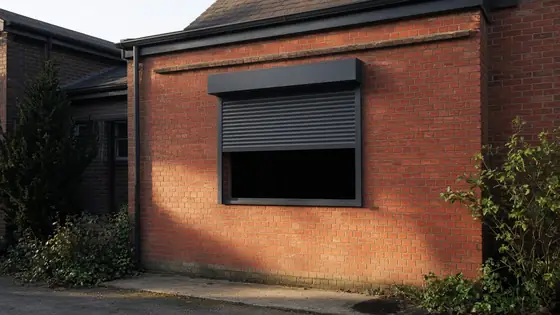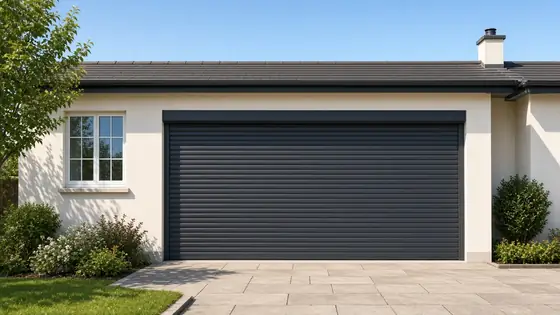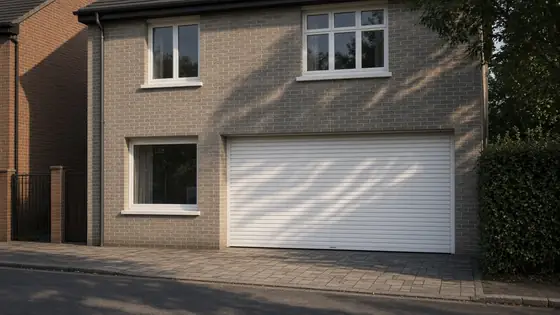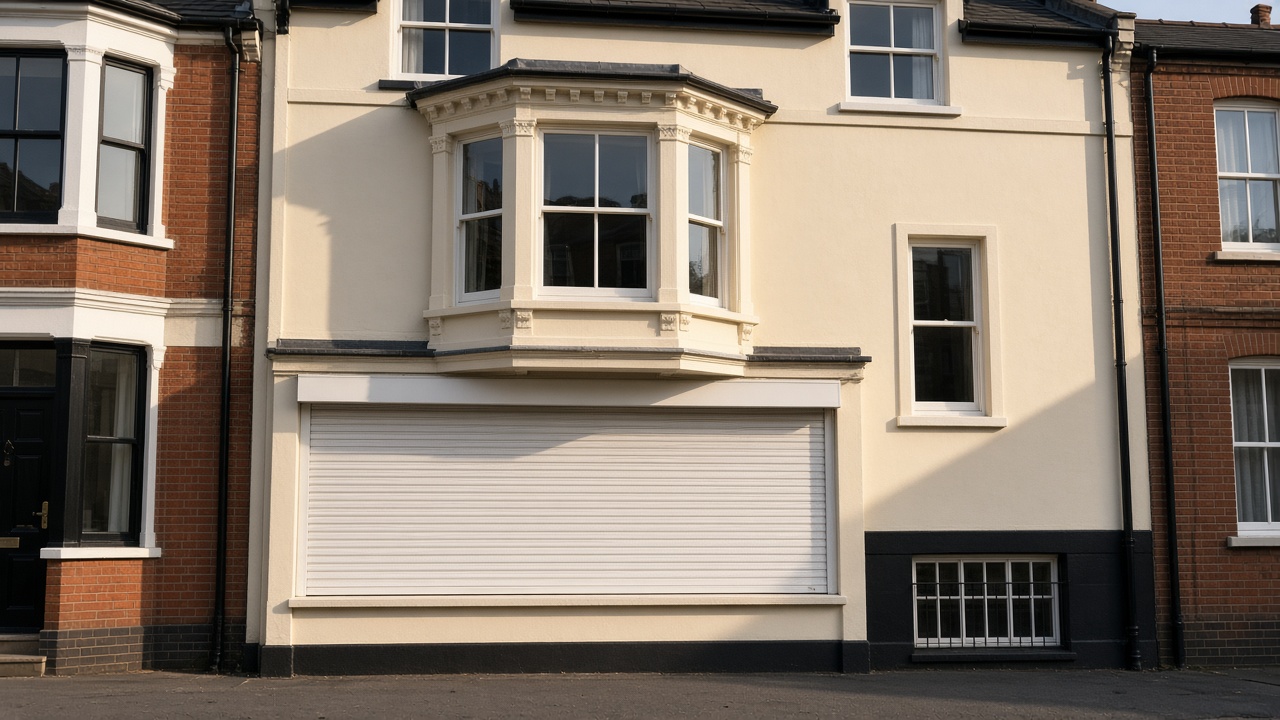
Insulated roller shutters (also sold as insulated rolling shutters) are external roller shutters with double skin aluminium slats filled with polyurethane foam, fitted with seals in the guides and at the bottom rail so that, when closed, they hold a still layer of air against the window. The window standard BS EN ISO 10077-1 treats a closed shutter as an extra thermal resistance (ΔR) added to the window. As a worked example, a shutter with a declared ΔR of 0.22 m²K/W, the bar a French energy saving grant scheme sets, would take an older 2.8 W/m²K double glazed window to about 1.7 W/m²K while it is down. A real shutter's ΔR is only known if its maker declares one, and it depends on how airtight the guides are and how the box is insulated, more than on the foam.
Key points
- "Insulated" normally means foam filled double skin aluminium slats. The foam alone does not decide the result.
- A closed shutter adds a resistance, ΔR, to the window. BS EN 13125 classes shutters by air permeability to set that figure.
- Ask the maker for the shutter's declared ΔR or air permeability class. Without one, no figure on this page can be assumed for that product.
- The box is there day and night. A badly insulated built in box loses heat all day, not only while the shutter is down.
What "insulated" means on a roller shutter
A domestic insulated roller shutter slat is two thin skins of roll formed aluminium with a core of polyurethane foam. heroal, which says it invented the foam filled aluminium roller shutter slat, describes the fill as polyurethane foam. The foam stiffens the slat and slows heat through it, but the slat is only one layer of a system.
Most of the effect comes from the air the closed curtain traps against the glass. If air can move freely round the edges, through the guides or under the bottom rail, that layer is lost and the slat fill matters very little. That is why two quotes that both say "insulated" can perform very differently.
What a closed shutter does to a window's U value
BS EN ISO 10077-1, the standard used to calculate a window's U value, covers windows with a closed shutter as well as without. European Aluminium's guide to the method sets it out: the U value of the window with the shutter closed is 1 ÷ (1 ÷ Uw + ΔR), where Uw is the window on its own and ΔR is the additional thermal resistance of the closed shutter. BS EN 13125 classifies shutters by their air permeability so that ΔR can be worked out under EN ISO 10077-1, for shutters that enclose an air layer between roughly 15 mm and 300 mm deep.
We found no UK grant or rule that sets a ΔR for shutters, but France publishes one. Its energy saving certificate scheme (certificats d'économies d'énergie, operation sheet BAR-EN-108, "fermeture isolante") only issues certificates for a shutter whose ΔR is greater than 0.22 m²K/W, shown on a document from the maker or an accredited body, and fitted by a qualified professional. That is a funding threshold in France, not a UK standard or a product class. The table uses 0.22 as an illustration on two typical UK windows; a shutter sold in the UK only reaches it if its maker declares that figure.
| Window | Open | Shutter closed | Averaged over 24 hours, closed 8 hours |
|---|---|---|---|
| Older double glazing | 2.8 W/m²K | About 1.7 W/m²K (38% lower) | About 2.4 W/m²K (13% lower) |
| Modern double glazed door | 1.4 W/m²K | About 1.1 W/m²K (24% lower) | About 1.3 W/m²K (8% lower) |
The arithmetic is ours, using the formula above. The 24 hour column uses the time weighted form in the same European Aluminium guide: (1 minus the share of time closed) × Uw, plus the share of time closed × the closed value. Two things follow. The worse the window, the bigger the gain. And a shutter only helps while it is down, so the night routine matters as much as the spec. heroal puts its own figure on it: up to 44% of energy can be saved at night with closed roller shutters. That is a maker's claim with no stated window or test.
Our winter heat loss calculator assumes a closed shutter cuts about a quarter of the heat flow through the glass, which sits below the 38% worked out here for older double glazing. Treat it as a cautious figure.
The box and the thermal bridge
The curtain only helps while it is down. The box is there all the time. heroal says completely surface mounted shutter boxes "do not create any cavities and hence no thermal bridges". A box built into the opening, cut into the lintel or set behind render can interrupt the wall insulation, and in a cold spell that can show as a cold, damp line on the inside head of the window.
Germany has a published guideline for roller shutter boxes, the RokR (Rollladenkasten-Richtlinie). A research summary on revising it, hosted by Fraunhofer IRB, gives the minimum requirement as a box U value (Usb) of 0.85 W/m²K or better. The same study found that, under the 2018 calculation method in EN ISO 10077-2, insulation placed on the outside of a slightly ventilated roll space is "virtually no longer effective". For a built in box, ask where the insulation sits relative to the roll space and for the box's Usb. Our guide to built in shutter lintels covers that detail.
Airtightness: guides, bottom rail and strap
Because BS EN 13125 classes shutters by air permeability, the gaps are what move a shutter up or down the scale. heroal says tightly sealing end strips are what ensure the heat insulating function. In practice that means three places.
First, brush or rubber inserts along both guides, so wind cannot circulate behind the curtain. Second, a rubber seal on the bottom rail that meets the sill. Third, the drive: a belt drive's strap passes through the wall into the room, which is an air path a motor or crank avoids. On the quote, ask for each by name.
| Part | Ask for | What goes wrong |
|---|---|---|
| Box position | A front mounted box outside the wall, or a built in box with insulation on the room side and a Usb figure | A built in box that breaks the wall insulation leaves a cold line indoors |
| Guide seals | Brush or rubber inserts along both guides | Air circulates behind the curtain and the still air layer is lost |
| Bottom rail | A rubber seal that meets the sill | Wind gets under the curtain |
| Slat | Foam filled double skin aluminium; ask for the ΔR or air permeability class | Perforated slats let air through by design |
Insulated rollers against extruded, plantation shutters and curtains
People searching for insulated shutters are often choosing between an outside roller, inside shutters and good curtains. Each keeps heat in a different way, and only some have a published figure.
| Option | How it holds heat | Published figure |
|---|---|---|
| Foam filled aluminium roller shutter | Still air layer outside the glass, sealed guides, foam slat | Only the maker's declared ΔR, if given. heroal claims up to 44% at night |
| Extruded aluminium security roller | Solid aluminium slat built for strength | No ΔR figure found from the makers we checked |
| Traditional interior timber shutters | Solid panels close inside the glass, trapping air | Historic Environment Scotland: timber shutters reduce heat loss by 51% |
| Louvred plantation shutters | Louvres close inside the glass | None found; the 51% figure is for traditional timber shutters, not louvres |
| Heavy lined curtains | Fabric layer inside the glass | Historic Environment Scotland: 14% |
These figures come from different methods and windows, so they are not a league table. Historic Environment Scotland's figures sit on its page about sash windows, where it also says secondary glazing can cut heat loss by 63% and by more than 75% when combined with blinds and shutters. If you need a security slat and warmth together, say so at the survey; see extruded versus foam slats. For using shutters through the cold months once they are fitted, see roller shutters in a British winter.
A worked figure for a three bedroom semi
Take the rear of a semi with older double glazing at about 2.8 W/m²K: a bedroom window of 1.2 m by 1.2 m, a lounge window of 1.8 m by 1.5 m and a patio door of 1.8 m by 2.1 m. That is about 7.9 m² of glass. With our calculator's cautious quarter (12 degrees between inside and outside, shutters down for 8 hours), the three openings lose roughly 2.1 kWh a night uncovered and save about 0.5 kWh a night with the shutters down, or around 80 kWh over 150 cold nights. A shutter with a declared ΔR of 0.22 would save nearer 0.8 kWh a night on the same glass.
From our external shutter price table, manual shutters for those three openings cost about £1,850 to £3,100 fitted, or roughly £3,050 to £5,150 with solar motors. Nobody should buy them for the heating bill alone. The winter case is comfort, because the glass stops feeling like a cold radiator; the rest is summer heat, darkness and security.
When paying more for warmth is worth it
The table above shows the gain is largest on the worst glass. Spend on the seals and the box before a thicker slat.
- Single glazing or early double glazing you cannot replace, for example under planning controls.
- Large glazed doors you sit next to in the evening, where the cold glass is what you feel.
- Bedrooms on exposed elevations, where sealed guides also keep wind from getting behind the curtain.
- Not worth extra money: a slightly thicker slat on already good glazing.
Frequently asked questions
What makes a roller shutter insulated?
Double skin aluminium slats filled with polyurethane foam, plus seals in the guides and on the bottom rail. The box position and those seals decide most of the result.
How much does a closed roller shutter improve a window's U value?
Under BS EN ISO 10077-1 the closed shutter adds a resistance, ΔR. With a declared ΔR of 0.22 m²K/W, a 2.8 W/m²K window drops to about 1.7 W/m²K while the shutter is down, by our arithmetic. Ask the maker for the ΔR of the shutter you are quoted.
What is ΔR on a shutter?
The additional thermal resistance a closed shutter adds to a window, in m²K/W. BS EN 13125 classes shutters by air permeability to set it. France's energy saving certificate scheme only issues certificates for shutters declared above 0.22 m²K/W.
Are insulated roller shutters more expensive?
Not usually. Foam filled slats are the usual domestic slat. From our published table a manual shutter on a standard window is typically £450 to £800 fitted, and £700 to £1,400 electric or solar.
Can a shutter box cause condensation?
A built in box that breaks the wall insulation can leave a cold line inside the window head. A surface mounted box outside the wall avoids the thermal bridge.
Are insulated shutters better than thermal curtains?
Historic Environment Scotland gives 14% for heavy lined curtains and 51% for timber shutters on its sash window page. Roller shutters are rated by ΔR instead, so the figures are not directly comparable.
Is this different from your winter heat loss guide?
Yes. This page is what to specify when buying. The winter guide covers how to use shutters through the cold months once they are fitted.
Sources and further reading
- BS EN 13125:2001, shutters and blinds: additional thermal resistance, allocation of a class of air permeability (scope via the NZ Building Code Hub listing), checked 29 Nov 2026
- European Aluminium: energy balance to assess the thermal performance of windows (EN ISO 10077-1, Uw,s = (1/Uw + ΔR)⁻¹ and time weighting), checked 29 Nov 2026
- French Ministry for the Energy Transition: energy saving certificate sheet BAR-EN-108, fermeture isolante (ΔR greater than 0.22 m²K/W), checked 29 Nov 2026
- heroal: roller shutter systems (foam filled slat, up to 44% at night, surface mounted boxes and thermal bridges, sealing end strips), checked 29 Nov 2026
- Research summary on IRBnet (Fraunhofer IRB): effects of the revision of EN ISO 10077-2 on roller shutter boxes, RokR minimum Usb 0.85 W/m²K, checked 29 Nov 2026
- Historic Environment Scotland: how to reduce heat loss from sash windows (timber shutters 51%, heavy curtains 14%, secondary glazing 63%), checked 29 Nov 2026
- Local Shutter Installers: external roller shutter price table, 2026